Authors: Ezaque Lopes Michelle Moore

These otherwise rising trends are marked with periods of fluctuation, evidence of growing pains and employee pushback. Nevertheless, the scope and magnitude of the transformation are already apparent, and organizations ignore the trends at their own risk. In this rapidly changing environment, leaders must navigate an equally thoughtful, proactive and employee-focused approach to position their organizations for success.
Facilitating hybrid and remote work
Remote work models were becoming more common long before COVID-19 caused a step-change acceleration of the trend. Five years since the start of the pandemic and more than three years since it was safe for most people to return to the office, the model's popularity is now firmly established. Even team-based work can be efficient in a remote work environment due to the availability of technology that supports collaboration. One notable outcome of the model is that work is moving faster, including the expectation for quicker responses to messages from colleagues, customers and business partners.
While some organizations have tried, with varying degrees of success, to mandate a return to the office, there's growing appreciation among both employers and employees of the advantages of remote work, including increased productivity coupled with improved work-life balance. At the same time, there are drawbacks to remote work, such as missed opportunities for informal and unplanned interactions that can facilitate innovation, retain talent and help build team cohesiveness.
Organizations can take steps to improve the trade-offs between hybrid and remote work and in-office work. A results-only work environment (ROWE) measures performance based on employees' work output quality, timeliness and efficiency. A ROWE is a particularly good fit for remote work, and it can also help organizations navigate generational differences in employee expectations. Younger Gen Z workers, for example, are more likely to expect a high degree of autonomy in determining when, where and how they fulfil their responsibilities.
Team leaders can also be more mindful in using technology to address the gaps in remote work interactions, such as the creative use of virtual workspaces and employee-generated avatars to support teambuilding. Those who have the option to meet in person periodically can use that meeting time selectively for strategic conversations that can strengthen teams while helping to drive the organization forward.
Promoting the adoption of GenAI tools
The public launch of ChatGPT in November 2022 marked the opening chapter of a profound transformation of how work gets done. Since then, leading technology companies have rushed to develop their own generative artificial intelligence (GenAI) platforms and embed GenAI capabilities into a broad range of existing applications.
These developments have confronted leaders across virtually all industries with the need to understand the implications for their organizations and develop strategies to address them. Not surprisingly, they've also created concern among employees about potential job losses, along with some degree of disappointment and frustration with the current state of the technology for those who've already experimented with the tools in their work. Furthermore, they've created risks for organizations that haven't provided employees with clear guidance on using these tools.
In this environment, it's important to understand the very different approaches organizations should take to "Big T" and "Small T" adoption efforts. Big T refers to the strategic use of technology to enable innovative approaches to critical business functions such as customer service, while Small T refers to the use of technology by individual employees to improve their effectiveness in communication and personal productivity.
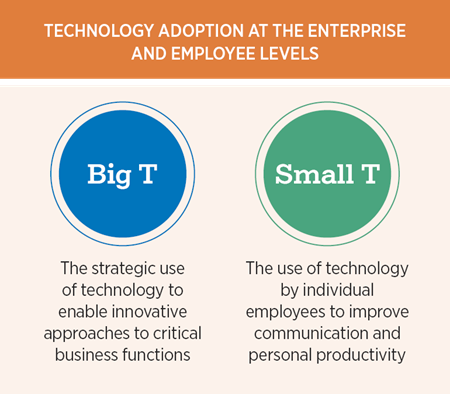
Most organizations have no choice but to be proactive in identifying the most meaningful opportunities for Big T initiatives and deploying top-down strategies for addressing them. Those strategies likely involve some combination of hiring, contracting or partnering to access the specialized resources required to conceptualize, design, develop, test and deploy the new solutions.
One especially important Small T application consideration is the need to provide employees guidance on the necessary boundaries around GenAI use so proprietary information isn't inadvertently exposed. Another is the need to address the impediments to adoption, including apprehension about using GenAI and training so employees get the most from the technology.
Employers can take multiple strategies to help manage the Small T adoption challenges. One is establishing an early adopter group to develop and test use cases to share experiences and best practices. Another is to find ways to reduce the fear and increase the fun associated with the adoption process, such as voluntary learning forums. Leaders at all levels can accelerate broader adoption among peers and team members by using the technology and explicitly sharing their experiences and results internally.
Maintaining balance while riding the innovation wave
Innovation is rarely, if ever, a simple, straightforward process. Substantial risks are involved in coming either too early or too late to the table when fundamental shifts are underway in how work gets done. Early adopters risk creating excessive internal disruption and investing in unsuccessful solutions. Late adopters risk placing themselves at a severe disadvantage to competitors that have already mastered the new ways of work.
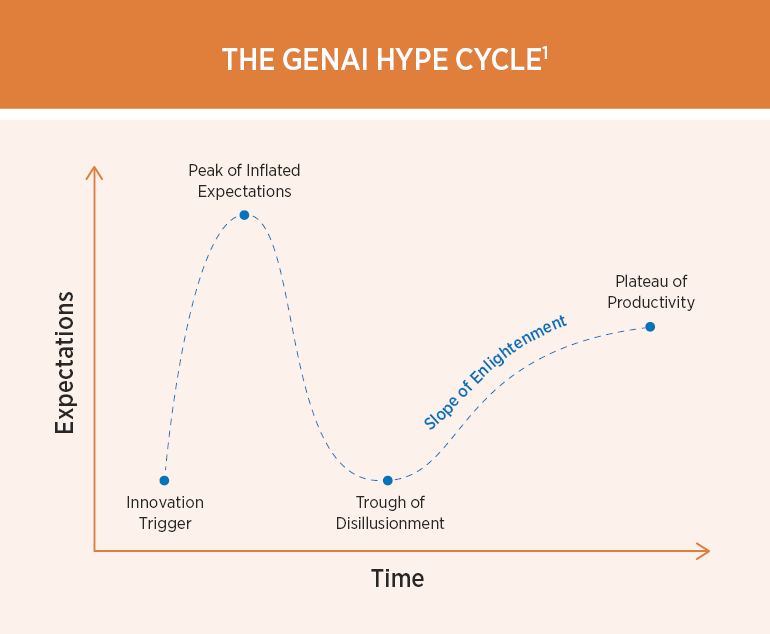
When it comes to the adoption of innovative technologies, organizations tend to follow a predictable cycle. Many rush to adopt during an initial phase of enthusiasm marked by inflated expectations amid excessive hype. Then, when they encounter the inevitable limitations of early-version technology, disillusionment sets in, and they pull back on their efforts.1
Organizations reengage at varying paces as the technology matures and early adopters demonstrate its value. Over time, the technology becomes widely embedded as an essential enabler of how work is done. Employers can gain a competitive advantage by avoiding both the highs and the lows of this hype cycle.1
Adapting to new ways of working
There isn't a one-size-fits-all approach to where and how people work. Not everyone will be equally effective at remote work, nor will they be similarly adept at incorporating technology like GenAI into their work processes. Even individuals and teams that are relatively experienced with remote work or technology adoption have learned to be selective in when and how they deploy these approaches and creative in addressing the inevitable trade-offs.
Leaders and managers need to recognize these differences and actively manage the implications at the individual, team and organizational levels. Regular, active listening to employees through pulse surveys and other means is crucial. But often, the bigger challenge is translating any learnings into action and establishing a clear connection to business priorities. Benchmarking similar organizations, within and outside the industry, can also provide powerful insights to help identify areas where an employer is relatively advanced or may be behind the curve. Ultimately though, adapting to new ways of working will help employees and organizations alike stay competitive in the evolving landscape of where and how work gets done.