Author: Martin Delaney

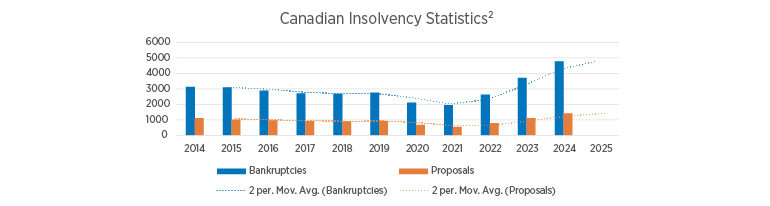
The rapid exposure to new volatile conditions brings constant challenges to businesses in Canada and overseas. Data from the Canadian Association of Insolvency and Restructuring Professionals shows 1,312 companies filed for bankruptcy in the third quarter of 2024, the highest since the 2009 financial crisis. In Ontario, bankruptcy filings rose 67% year-over-year in Q3, while Quebec saw a 40% increase.1 High-risk sectors include construction, retail, and hospitality and leisure.
Organizations aiming to balance future growth plans with current balance sheet protection can benefit from trade credit insurance as a credit risk mitigation tool that supports their business decisions. Many companies incorporate trade credit insurance into their overall risk management strategy to safeguard against bad debt losses in their accounts receivable portfolios. For multinational companies, trade credit insurance is commonly used to manage B2B-receivables risk-concentration concerns and to facilitate the extension of open credit necessary for cross-border transactions.
What is trade credit insurance?
Trade credit insurance provides a layer of protection for businesses against the risk of nonpayment for goods or services sold on credit, whether in domestic or international markets. This coverage is especially valuable given the complex cash-flow cycles and extended payment terms that many companies face. If a customer or subcontractor fails to pay — often due to insolvency or prolonged default beyond an agreed-upon period — trade credit insurance can provide crucial financial protection, helping businesses maintain stability and continue operations with confidence.
Trade credit insurance provides many benefits, including providing insights into the financial health of new and existing customers by using the insurer's real-time credit intelligence and risk scoring/rating systems and providing an early indication of potential problems.
A number of risks can be insured under trade credit insurance products, including:
- Nonpayment or late payment
- Customer bankruptcy, insolvency or similar legal status
- Nonpayment following an event outside the control of the buyer or seller
- Negative impact on businesses due to political instability or changes, such as conflicts, regime changes or international policy shifts
- Cancellation of fixed contracts due to pre- and post-delivery risks
- Pre-delivery risks include political violence, war, embargoes and license cancellations.
- Post-delivery coverage includes the fair or unfair call of performance bonds, typically backed by a letter of credit from a financial institution.
Note that insured risks must have a direct link with the delivery of goods or services, otherwise they aren't insurable.
Claims scenario: Closing deals overseas
Claims scenario: The missing company
Did you know?
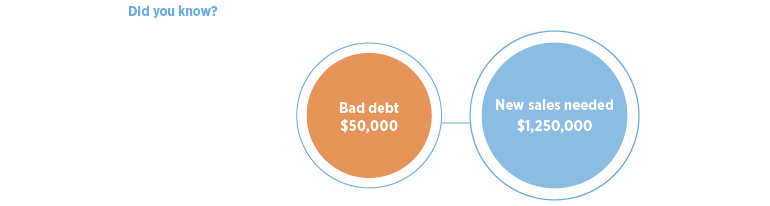
Bad debts can have a devastating impact on businesses. Replacing lost revenue on the balance sheet requires a significant increase in extra sales. A business with $50K in bad debt and a net profit margin of 4% would need $1.25 million in extra sales to recover the loss, and this number is before taking interest charges into account.
The current climate
Canadian businesses continue to operate in a difficult trading environment against a backdrop of ongoing global economic and political uncertainty. Conflicts and global tensions have led to spikes in global energy prices and transportation routes have been heavily impacted by the attacks in the Red Sea, resulting in extensive diversions.3 Additionally, geopolitical pressures can result in new tariffs, trade barriers and regulatory changes that complicate international trade. These disruptions can also result in longer lead times, increased costs and decreased efficiency, making it challenging for businesses to maintain smooth operations.
We've yet to see the true impact of how recent large business insolvencies have affected suppliers, debtors and customers due to unpaid debts. This effect will be felt throughout the supply chain and take place over many years.
With a new Canadian government and nearly 80 elections held worldwide in 2024, it's difficult to predict the future direction of many countries and the businesses that operate within them. By understanding your business risk profile and investing in solutions such as trade credit insurance, you can help mitigate these exposures and safeguard yourselves against any potential challenges in the future.