Authors: Jacob Hall Michael Poaps Chris Lee

Consolidating the number of different third-party vendors can make it easier to understand and access what's being offered. At the same time, effectively and consistently communicating the value of benefits drives engagement and helps ensure the investment is worthwhile.
Surveys show that employees often find the range of benefits available to them confusing. A scaled-back approach that's clear and easily accessible can offer more value than an all-encompassing program while also helping at the back end by reducing the overall benefit administration burden and cost.
The case for simplification
Benefits professionals know that engaging with multiple vendors creates hurdles in coordination, compliance and communication. With more than half of organizations reporting little to no capacity within their HR teams, employers are increasingly looking for ways to make managing benefits and retirement administration more straightforward.1 Those seeking efficiencies are driving the push for simplification.
Often, an employer will deal with a different vendor for each group of services (such as group health, virtual healthcare, employee assistance, life insurance and financial wellbeing). By consolidating, HR teams can reduce the complexity of dealing with multiple vendors and benefit administration processes.
Administrative onboarding with fewer vendors expedites the implementation process and reduces the risk of errors. Collaborating with a single team of individuals who know the organization's unique needs and makeup is more efficient and effective than working with multiple contacts at different companies. This simplified approach can save costs by eliminating administrative redundancy and allowing HR professionals to focus on other strategic priorities.
Simplification can increase employee engagement and understanding of benefits too. When benefits are accessible through a bundled platform or single sign-on portal, employees are more likely to recall and use them. They also gain a more holistic view of their benefits. For example, when employees access the portal to check their retirement balance or update beneficiaries, they can see the other benefits available to them.
There's also the potential for reduced burden in benefit administration for the employee if enrolment paperwork is streamlined, available online and turned around quickly. An easy and efficient enrolment process from the vendor differentiates it by promoting employee engagement with benefit programs.
Integrating data to drive more informed decisions
While the market works to catch up to employer demand for data integration across multiple programs, the move toward bundling vendors helps to ensure employers are well positioned to leverage these capabilities once they're fully available.
Data is a powerful tool, and vendor consolidation offers greater potential to integrate data across multiple benefit programs. The resulting analytics provide insights critical for assessing how benefits are being used and identifying low-value services. These insights also enable more effective targeting of employee benefit communications to support further engagement.
It's important to note that integrating programs doesn't automatically lead to better data insights. While data is crucial for driving decisions, current systems often report data in separate streams, limiting the ability to identify cross-program trends. However, data analytics capabilities are evolving rapidly, and the potential for this challenge to resolve itself is promising.
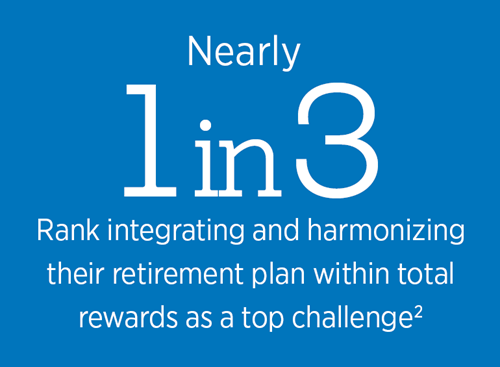
Among the current hurdles to overcome in the drive for better data and analytics is the technical difficulty in aligning disparate and sometimes legacy systems. For instance, 31% of employers report that integrating their retirement plan with other total rewards is challenging.2
On the other hand, harmonizing retirement administration with other benefits enables employers to offer comprehensive financial education and planning resources. Those resources help employees make more informed decisions about their financial futures and encourage them to use their benefits better.
Prioritizing employee benefit communication
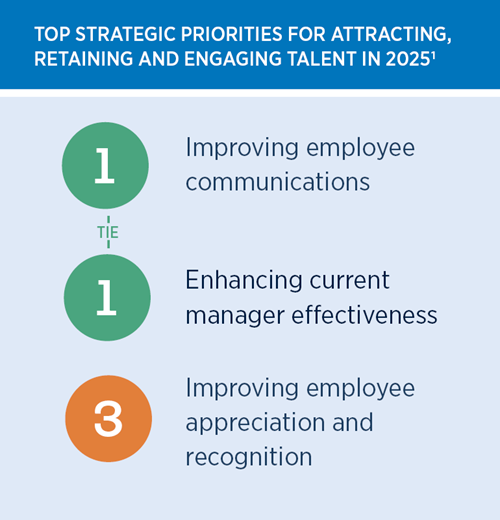
A mindset centred on efficiency and simplification should also infuse employee benefit communication. Well-crafted and targeted communication has the power to convey and enhance the value of benefits. Think of employee message development through a marketing lens.
Focused "what's in it for me" messaging can cut through the noise that competes for employees' attention — maximizing its impact. If employees don't understand and appreciate their benefits, the investment made by the organization isn't a competitive differentiator.
The right messaging can prevent an organization from adding or enhancing benefits unnecessarily. Employees can take even the most robust benefit administration program for granted if they're unaware of or don't appreciate the value offered.
Educating employees about their benefits often leads to organizations getting more mileage out of existing coverage at a fraction of the cost of program additions or enhancements. Use real-world employee stories, plain language and consistent messaging to engage employees and bring their benefits to life.
Aligning considerations for simplification with organizational needs
Simplifying benefit administration offers significant advantages, particularly in reducing administrative burdens and enhancing employee engagement. However, it's not a one-size-fits-all solution. Organizations need to carefully weigh the benefits against potential drawbacks, such as the loss of vendor choice and limitations in data integration.
Ultimately, the key to maximizing the value of benefits lies in a strategic approach that combines simplification with effective employee benefit communication. By helping employees understand and appreciate their benefits, organizations can foster a culture of wellbeing and support that aligns with their overall goals.
As the benefit administration industry continues to evolve, tailoring strategies to meet each organization's unique needs helps ensure that simplifying benefit administration and leveraging targeted communications truly enhances value for both employers and employees.