Authors: Farzeen Mawji Lara Gibbs

Inclusion and diversity (I&D) policies have become a central theme in political, social and business discourse. From 2020 to 2022, many organizations placed more emphasis on I&D, often hiring internal resources or external consultants to develop I&D policies. But since 2023, the pendulum has started to swing in the opposite direction, positioning I&D as a polarizing topic.
The change in tone in the discussion of I&D initiatives may have employers scratching their heads about the appropriate course of action. The first step should be taking stock of what's happening in I&D discourse and acknowledging that the political landscape has significantly influenced perceptions. In Canada and elsewhere in North America, I&D initiatives have been prominent talking points — often leading to misunderstandings and misinterpretations.
Some media headlines suggest that organizations are abandoning I&D initiatives. However, many employers are simply refocusing their efforts while maintaining the core principles of inclusion and diversity. Yet misperceptions can trickle into business settings, creating questions for employers.
Making sense of recent developments
So what's driving the pendulum swing and augmenting misperception? Not surprisingly, there are multiple factors, but one in particular stands out in 2025: individual and collective fears of losing out. As an increasingly polarizing topic, both mainstream media and social media serve as platforms for diverse perspectives on I&D. In an era of disinformation and misinformation, it can be difficult to know who and what to trust.
Fear-driven reactions often arise in response to equity discussions. Among the components of inclusive policies, equity is frequently the most challenged. Critics argue that equity initiatives provide unfair advantages to non-dominant groups, perpetuating a perception that these efforts result in the hiring and promotion of unqualified individuals.
This fictional narrative is often driven by the fear of losing opportunities, both in professional and personal spheres, leading to the erroneous belief that I&D initiatives compromise meritocracy. This perception contrasts with data about the business case for I&D policies and creates a "fear-fueled fiction," a term that encapsulates the misconceptions and anxieties surrounding I&D initiatives.
Such a perspective overlooks the core meaning of equity and efforts to address systemic barriers that have historically limited access to opportunities for marginalized groups. Equity aims to level the playing field by helping to ensure that everyone has the chance to succeed based on their capabilities, not their background.
By addressing misconceptions and emphasizing the true intent of equity, organizations can help dispel fear-fueled fiction and foster a more dynamic workplace with merit-based opportunities for advancement.
Delving deeper into I&D strategy trends
I&D may seem like a very 21st-century topic, but the principles have been a focus of discussion since at least the 1960s. A benefit of this long conversation is that data has been collected over many decades, demonstrating time and again that I&D policies are the right thing to do and that they're good for business.
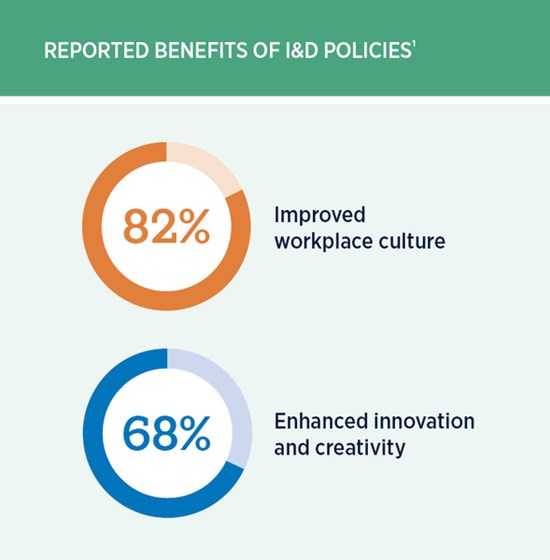
More than four out of five HR respondents cited an improved workplace culture because of I&D policies, and more than two-thirds found that I&D enhanced innovation and creativity.1 Inclusive organizations are also 73% more likely to reap innovation revenue, 70% more likely to capture new markets and up to 36% more likely to have above-average profitability.2
Determining the right organizational approach
By implementing sound business practices, employers play a unique role in bridging the gap between I&D public discourse and practical implementation. Inclusive organizations, where every employee feels valued and empowered to contribute their best, enhance workforce morale and provide a steady counterpoint to varying sentiments as the social and political pendulum swings back and forth on I&D initiatives.
To effectively determine the right organizational approach to I&D policies, assess past programs and identify what's worked well and what areas require improvement. By harnessing the energy and momentum built from previous I&D initiatives, organizations can capitalize on successful strategies while addressing shortcomings. This reflective process enables more inclusive relationships and environments where everyone has a voice. Moving toward co-creating a path forward helps ensure that no single group dictates I&D strategy and that a collective endeavor meets employees where they are and guides them toward a shared vision.
Finding common ground is key to advancing I&D policies without falling into the extremes of polarizing debates. Organizations must strive for a balanced approach that emphasizes equity without resorting to rigid targets or quotas. Equity should be about increasing access to opportunities and proving capabilities, ultimately serving the business by attracting a high caliber of talent. This merit-based approach helps the bottom line and appeals to workers who value inclusive practices. Aligning I&D efforts with business objectives allows organizations to create a sustainable model that benefits everyone.
Working toward a culture where merit shines
Embedding I&D strategy into the rhythm of how a business operates is more than just aspirational; it's achievable, although it's an ongoing process. Tapping into the human element that compels individuals to strive for inclusivity is key — and particularly crucial for retaining talent. Employees at organizations with I&D policies are more likely to report being satisfied with opportunities for growth and development (78%) than those without I&D initiatives in place (64%).3
When organizations fail to consider workforce expectations, they risk alienating a significant portion of their population. I&D shouldn't be a reactive movement, confined to a specific moment, but an ongoing commitment, bringing everyone into the fold and making them feel uniquely included and valued.
In an ideal scenario, I&D policies are integrated seamlessly into organizational operations rather than existing as a separate entity. By adopting a broad, merit-based approach, organizational leaders help ensure that every candidate is evaluated on the same metrics, fostering transparency and fairness. Such an approach benefits all groups — including those that might traditionally rely on informal networks — by providing a clear and equitable framework for evaluation. It serves as a measure of protection and assurance that merit truly guides the decision-making process.
To achieve this status, organizations need to move beyond performative gestures and treat I&D as an evolving initiative, continuously assessing and refining existing systems. The goal should be to inspire individuals to perform at their best, creating an environment that doesn't disenfranchise but instead empowers.
It's understandable, in the current climate, that employers are looking to take some of the heat out of the discourse around I&D. But they don't have to abandon the progress they've made. By embedding I&D initiatives into the core of organizational culture, businesses help ensure their longevity and relevance, making their I&D strategy a lasting and integral part of their operations. This commitment to merit and acceptance enhances organizational performance and builds a workplace where everyone can thrive.
Want to learn more? View our Inclusion and Diversity Consulting overview.