
There’s no excuse for falling back into the feelings of pre-pandemic insignificance many of you are all-too familiar with.
Global Practice Managing Director

Internal Communication

For internal communicators, the spectrum of employee experience (EX) – culture, wellbeing, reward and recognition, ways of working, future of work and career development – is a veritable smorgasbord of ideas when it comes to leveraging the people proposition via employee messages that count.
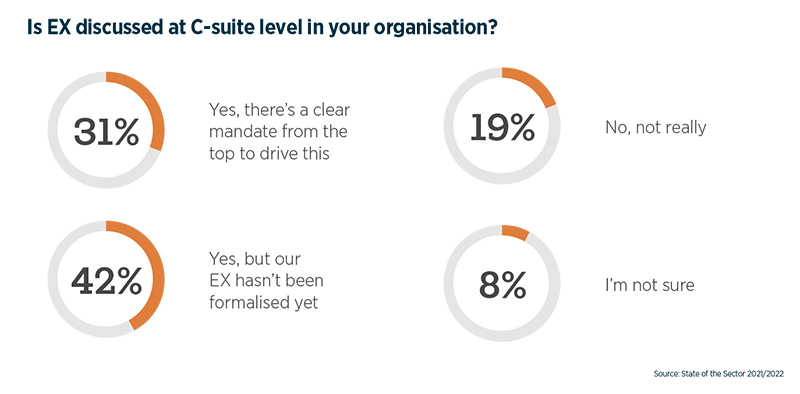
For us, seeing how broader employee experience themes are really starting to impact the way we work, collaborate, strategize and communicate is really something. And the fact that 73% of State of the Sector respondents are telling us that employee experience is driving C-suite conversations across all regions and organization types is music to our ears – we just need to keep using our new-found influence to make sure these conversations continue to drive organizational wellbeing and fuel the passion of our people.
But we shouldn’t need to tell you this. Whether you realize it or not, you’ve been using your expertise to influence proceedings at every turn during the COVID-19 crisis. So don’t stop now, just because we’re returning to some semblance of ‘normal’ – this is yours for the taking, so capitalize on your post-pandemic worth and take control of the employee experience narrative.
Your organization and its employees will be richer for it – and you’ll begin to realize your true value as a key player in the corporate agenda while you’re at it too. Sounds like a win-win to us!
In the same way that consumers look to brands, today’s employees want to understand what their chosen place of work actually stands for, and how their time and effort plays a part in making a difference. But we’re not necessarily talking about an organizational purpose or mission statement posted on a wall here; this is about the hire-to-retire employee experience. Internal communication plays a key role in delivering that message – and it’s up to you to let the decision makers understand the value that you add.
If you look at this specifically from the perspective of the CEO, their understanding of the internal communication function and how vital it is to an organization's performance has grown exponentially during the pandemic – and that is undeniably positive. However, we aren’t quite at the stage where CFOs have bought into generating the investment needed to amplify internal communication to where practitioners believe it should be quite yet. We’re getting there though – you just need to get closer to the leadership tier to get those budgets aligned.
The rise of internal communication in the corporate agenda has been significant during the pandemic, but it hasn’t been easy. There’s been an awful lot thrown at you, no doubt about it. But, as professionals, if you look at this as an opportunity to really understand your senior leaders and use your new-found influence to demonstrate the true impact that effective internal communication can have on an organization, there’s no excuse for falling back into the feelings of pre-pandemic insignificance many of you are all-too familiar with.
Yes, organizations are consistently going through change at the moment; and, yes, there’s an awful lot to do – but don’t let that get in the way of proving how vital internal communication is when it comes to nurturing a healthy organizational bottom line. And be bold in doing so: use your stellar performance during the pandemic as a benchmark when it comes to navigating through investment challenges. Keep pushing forward: stay relevant to the business agenda and essential to the corporate conversation.
There’s no excuse for falling back into the feelings of pre-pandemic insignificance many of you are all-too familiar with.
Global Practice Managing Director
