
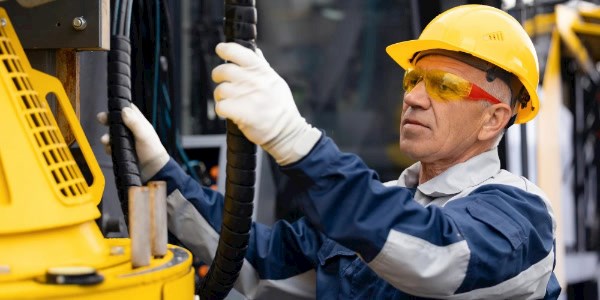
The practicalities of fostering safety in a high risk, decentralised and unpredictable work environment is one of the day to day complexities of drilling operations for mining companies. Identifying what's working currently, what doesn't work and where improvements are needed underpin safety management decisions.
Gallagher Workplace Risk expert Andy Campbell was a panellist at the 2025 Association of Mining and Exploration Companies (AMEC) WA Work Health and Safety Spotlight, along with representatives from Wallis Drilling, DDH1 Drilling and Hagstrom Drilling1 to discuss the issues involved.
While compliance frameworks have recently made hand injuries and manual handling a focus, fatal incidents involving driving, mobile equipment interaction and thermal stress are the areas that need more particular attention. The critical risks that can involve life altering or fatal injuries consistent across the sector: vehicles and driving.
Drilling safety culture on the ground is a leadership issue
To apply controls consistently across operations of varied scale and geography, leadership must evolve to meet the scope of the drilling operational risks. The Gallagher insight is that leadership, not paperwork, is what determines safety outcomes.
"Safety culture comes from the top, but is lived on the ground," Andy from Gallagher noted.
What is needed in drilling environments is for field managers to have the tools and support required, especially in isolated areas.
Schedule 26 obligations which cover how drilling companies are managing statutory supervisor requirements on remote exploration programs can only work if the supervisors have the capability and support to lead.
Drilling contractors' critical role in implementing health, safety and environment measures
Drilling operations can differ widely, from working with a junior explorer with no safety team and minimal induction to a blue chip company with a 12-month program and full time health, safety and environment (HSE) presence, and the workplace health and safety (WHS) onus often falls to the contractor.
This highlights the importance of communication between principals and contractors, especially when drilling companies are expected to both implement and enforce safe systems under vastly different resourcing conditions.
Safety training, especially where young recruits to the workforce are involved, is a key requirement.
Developments in technology have provided some assistance, such as equipment that eliminates manual handling of rods on rigs, but it's expensive and time consuming to retrofit.
The use of artificial intelligence (AI) integrated into closed circuit television (CCTV) to monitor exclusion zones or fatigue detection still involves issues of false positives to be resolved.
Achieving an industry-wide standard for drilling equipment and safety innovation is hampered by the high capital costs of implementation, especially in short-term projects.
While uniformity in training, maintenance and machinery parts reduces risk, culture plays a critical role in keeping everyone on a drilling site safe.
How Gallagher insurance supports drilling operations
Gallagher specialises in assisting organisations and individuals in navigating WHS risks and insurance implications. Our specialist brokers are available to help you obtain optimal outcomes, working in partnership with your team to support the implementation of effective and robust WHS risk management as well as tailored insurance programs that protect you now and into the future.