The global infrastructure investment shortfall is projected to reach an estimated USD97 trillion by 2040.1 Much of the infrastructure that will shape our future doesn't yet exist, offering a rare opportunity to embed climate resilience into its very foundation.
The need of the hour is to look through a new lens, moving from a "predict and prevent mindset" to that of "adapt and absorb."
"Coming from the private sector, I see a lot of talk about resilience," says Lorcán Hall, senior advisor to SDG Academy, part of the UN Sustainable Development Solutions Network. "Many people equate it with 'building back better', but there is a significant body of scientific research and thought around resilience.
"What we are discovering now is that it is not simply about rebuilding better; it is about rebuilding differently."
The window for change is open. Every new structure built with resilience in mind is a step toward safeguarding future generations.
This mindset shift is more prevalent in regions hit by extreme climate events, where proactive infrastructure reinforcement is considered "essential."
"People are thinking in layers," notes Nancy Sylvester, area executive vice president, Baton Rouge, Gallagher. "Developing two, three, even four layers of redundancies — so that incidents like Katrina never happen again."
“
People are thinking in layers. Developing two, three, even four layers of redundancies — so that incidents like Katrina never happen again.
Nancy Sylvester, area executive vice president, Baton Rouge, Gallagher
Rebuilding New Orleans
New Orleans today has been exemplary in its definition of resilience. When the city hosted the 2025 Super Bowl at Caesars Superdome, the theme was "Keep Going." It was a proud moment that reflected the city's unity, strength and unique spirit.
Beyond investing USD14 billion in re-engineering the levees to withstand once-in-a-lifetime floods, the city's adaptation measures acknowledge living with water, rather than just fighting it.

Upgraded storm defenses
Built by the US Army Corps of Engineers, the Hurricane and Storm Damage Risk Reduction System (HSDRRS) spans 350 miles of upgraded levees, flood walls, gates and pumps designed to withstand a one-in-100-year, 30-foot storm surge. It marks a major advance in protecting New Orleans and would likely have greatly reduced the impact of a storm like Katrina today.
The Greater New Orleans Urban Water Plan initiative, aimed at building citywide resilience to one-in-500-year flood events, works by slowing water down, storing and reabsorbing it using "green stormwater infrastructure" like bioswales and canals. It incorporates learnings in effective flood resilience from cities around the world, including Amsterdam and Rotterdam.
At the heart of the initiative is the New Orleans Mirabeau Water Garden, which has transformed 25 acres of land in the center of the city into a wetland park designed to hold up to 10 million gallons of excess floodwater. Another localized venture converts stormwater basins into vibrant public spaces.
This transition marks a shift in not just design, but also perspective.
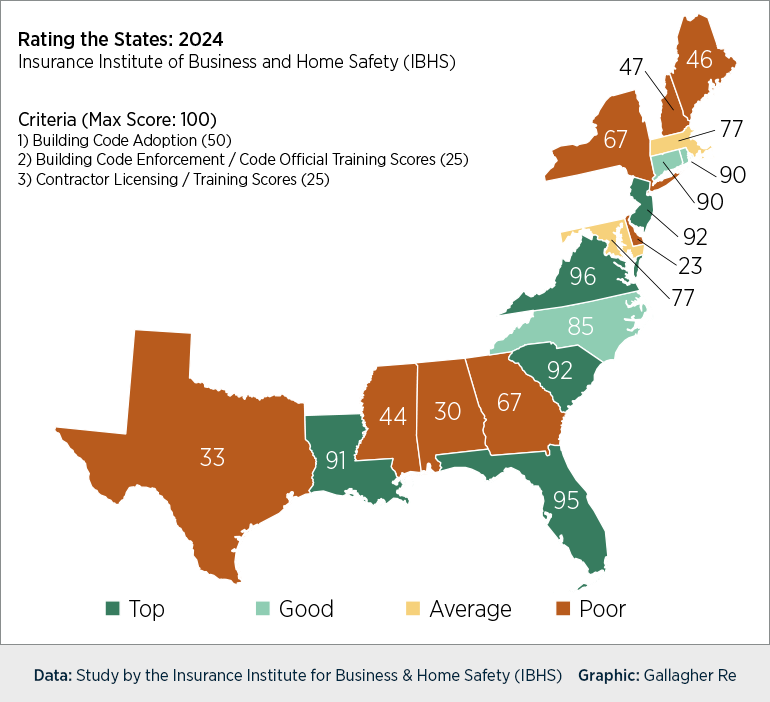
A 2024 Insurance Institute for Business & Home Safety (IBHS) study found Florida, Virginia, Louisiana, South Carolina and New Jersey to be best equipped to handle hurricane wind risk.
“
We saw proof of our resilience when Hurricane Ida, a Category 4 superstorm, struck about four years ago.
Greg Nichols, New Orleans' deputy chief resilience officer
"We saw proof of our resilience when Hurricane Ida, a Category 4 superstorm, struck about four years ago," says Greg Nichols, New Orleans' deputy chief resilience officer. "The levees held firm, and while a lot of rain fell, there was no widespread flooding."
The city is also focused on encouraging resilience at a grassroots level, equipping residents with rain barrels, French drains and green roofs to address lingering damages from previous storms and to help absorb excess water from future storms.
"Water doesn't disappear; it redirects. It's crucial to consider the bigger picture when building resilience," explains Zahra Jasmin-Uddin, a climate and environmental social and governance (ESG) analyst with Gallagher, about how every intervention sends ripples outward.
She explains that building resilience isn't just about strengthening infrastructure. It's about anticipating chain reactions and designing with the full ecosystem in mind.
Harnessing rain: An urban revival through green stormwater infrastructure
The Haegan Lafitte project was designed to build neighborhood resilience via eco-engineering in New Orleans' mid-city area between the Lafitte Greenway and Orleans Avenue. The project spans 33 acres, including 23 blocks of residential and commercial areas, and a neighborhood park — interspersing green initiatives within gray infrastructure.
Sixty rain gardens with native species like Muhly grass and Dwarf Palmettos were installed to absorb and filter rainwater. These include curb cuts to channel street runoff. The park also has been retroactively fitted with a massive underground storage tank for excess stormwater.
Working with Mother Nature: Encouraging "green" infrastructure
Globally, hybrid approaches that blend gray and green infrastructure have gained traction for storm fortification.
The Netherlands, for example, has ensured its rivers have room to safely overflow through measures like lowering floodplains and transforming vulnerable areas into multifunctional landscapes.2
"When the Greater New Orleans Urban Water Plan was being written, a lot of the folks involved spent time in the Netherlands looking at things like groundwater, because they have a lot of similarities with us," explains Nichols.
"The Netherlands is a low-lying country where sea-level rise is an existential threat. They also have large-scale engineering to protect them from the flooding threat, but they're probably even more focused on living with water than we are."
Eco-fortified "sponge cities," meanwhile, are being used in multiple places to restore the urban natural hydraulic cycle: capturing rainfall and filtering it through natural systems. Through its wetlands and permeable surfaces, the Chinese city of Shenzhen allows rain to mimic its natural journey, reducing flood risk and replenishing groundwater.
Such nature-based solutions increasingly define an adaptive blueprint for urban resilience amid escalating heat stress and weather whiplash, where very wet periods are quickly followed by very hot and dry periods.
On average, green infrastructure solutions are 1.5 times more cost-effective than traditional gray infrastructure in enhancing resilience to heat and wet extremes, catapulting land value and creating jobs.3
According to the World Economic Forum, regions with green stormwater infrastructures like mangroves, reefs, marshes and wetlands experience an average of 65% fewer insured flood losses during storms.
Gray and green infrastructure protection in Lower Manhattan
Seven years post-Katrina, the Gulf and Mid-Atlantic coasts were hit by another superstorm: Sandy. Although it made landfall in New Jersey as a weakened Category 1, the storm combined with another weather system to create a strong extratropical storm.
The surge from Sandy overwhelmed drainage systems, inundating parts of Manhattan's subway system, and basement shops and apartments. It damaged infrastructure, cut off roads and knocked out power to more than 2 million homes along the Eastern Seaboard.
Total damages reached USD30 billion, which in today's dollars is approximately USD41-45 billion.