
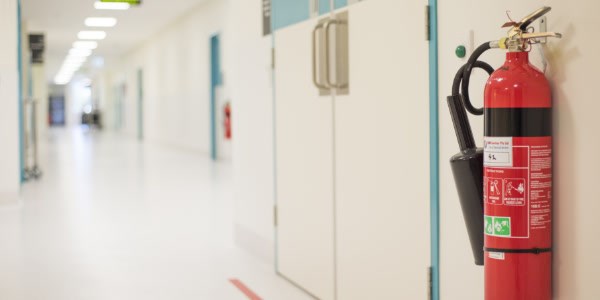
Fire risks are a threat to life, property and the environment, and taking appropriate precautions against them is a responsibility for every business. Awareness of fire risk exposures, mitigation measures and regular maintenance checks are essential ways to ensure your business premises complies with regulatory requirements1.
This is essential to preventing the devastating damage fires can have on businesses, not just to the premises and staff safety but also in terms of stock losses, business disruption/continuity and the ability to continue trading.
Practical risk mitigation measures: fire separation
There are a number of practical steps business owners can implement to reduce the risk of extensive fire damage or total devastation of their premises.
Building design or retrofitting that achieves fire separation can slow or reduce the spread of a fire within the building structure, or of it spreading to neighbouring properties.
This can be achieved through passive barriers to confine a fire within a particular area through the use of fire resistant materials in walls, ceilings, floors and doors that contain the spread of a fire.
This containment achieved by fire-rated separation can prevent fire reaching business critical areas, such as plant, IT servers, warehousing facilities, flammable materials, offices or workspaces. The National Construction Code (NCC) provides specific fire separation requirements for different building types2.
Obviously it's much easier to incorporate fire separation features into new builds, but existing buildings can be purpose retrofitted, using fire doors or designated fully protected cut-off areas to isolate other parts of the structure.
Attention should also be paid to pipes, cables or ducts that pass through fire-rated surfaces to ensure that openings are completely sealed. Another concern is if the fire-resistant wall is filled with combustible foam, such as expanded polystyrene (EPS).
For business operators leasing premises it's a good idea to ask the commercial property owner or agent for fire risk assessment information and a summary of the current controls and maintenance regime.
Fire risks are also a concern for insurers, who often want to see substantiated evidence of risk management when providing cover. This can influence premium costs as well.
Some of the fire risk factors to consider might include:
- the prevalence of lithium-ion batteries in a wide range of products
- the use of expanded polystyrene (EPS) for temperature insulation
- environmental factors like lightning strikes or bushfire hazards.
Fire safety in EPS insulated environments
Many premises in certain industries, such as food production, use EPS wall insulation for temperature control and this fire risk can be a concern for insurers. Making an EPS assessment involves checking that:
- any apertures in EPS walls or doorways are completely sealed
- there is no heat source near the combustible inner core of the EPS panel
- power sources that penetrate EPS are sleeved in a fire-retardant conduit and IT cables sleeved and located on metal trays away from switchboards and panels
- charging stationsfor forklifts, electric vehicles or two-way radios are situated well away from EPS walls.
Precautions around EPS panels are critically important to how the business's fire hazard is assessed. Insurers will require detail about the protection of EPS insulation and fire risk mitigation so business owners need to be prepared to provide proof.
Along with fire separation measures, that might include fire and smoke detection systems locations, thermographic imaging for all switchboards and fire panels and documented processes to ensure no combustibles are stored near areas with EPS panels.
Having thorough fire safety management procedures in place can significantly mitigate the risk of loss due to combustible EPS panels.
How to conduct regular checks of fire risk precautions
Conducting regular fire risk assessments should be an integral component in a business's risk management framework.
Some of the most common hazards in a business premise that can cause fires include:
- faulty equipment is a principal cause of a high percentage of fire incidents
- overloading power sockets is another common cause of electrical fires
- the use of heat processes such as welding or cooking can cause fire ignition if not properly managed
- improper storage of combustible materials such as cardboard, paper, paints, chemicals, and plastics can also lead to workplace fires.
Fire risk assessments involve comprehensive reviews of key standard fire safety compliance and identification of potential improvements to fire safety management practices.
Gallagher risk experts can support and advise on a business's fire risk assessment approach. While fire separation measures form an important aspect of risk management, systems and equipment such as fire extinguishers, sprinklers and emergency warning systems need to be regularly tested, and maintained in accordance with Australian Standard AS1851, Routine Service of Fire Protection Systems3.
How Gallagher can help
Insurance is an essential component in every business's ability to manage and face fire threats. For risk management and advice and ensuring your property insurance is adequate and up to date, talk to one of our business insurance specialists.
