
How to improve premiums on trucking insurance policies
Getting your Trinity Audio player ready...
null

Trucking insurance represents one of the highest fixed costs of a transport business. Understanding what insurers evaluate and how you can position your business as a lower risk can lead to substantial savings in the tight-margin business that is trucking.

Understanding premium influences

Insurance premiums are influenced by numerous factors, many beyond the control of owner-operators. Premiums often rise, posing a significant challenge for trucking businesses.

Trucking insurance premiums are based on estimated loss costs, which are influenced by individual risk characteristics, some of which owner-operators can influence themselves; and changes in the operating environment, which includes driving patterns, vehicle repair costs, medical costs and litigation.

Higher costs attributed to changes in the trucking industry environment can result in higher premiums, even for operators with a good claims record. Key factors include claims history, safety records, equipment quality and geographical operation areas.

How can trucking operators reduce insurance premium costs?

There are measures owner-operators can take to improve insurers' view of their businesses, aiming to be seen as low risk as possible, to secure the optimal rates and coverage options available.

Maintaining a clean driving and safety record is crucial. Hiring drivers with strong safety records and ensuring the carrier's safety standards remain high can prevent premium hikes.
The human risk safety factor in the trucking industry

According to long term statistics compiled by the Australian Bureau of Infrastructure and Transport Research Economics (BITRE) the number of heavy vehicle occupant deaths per year has increased1.
Due to the high rates of fatalities and/or injuries, transport is defined as a hazardous industry in the Australian Work, Health and Safety Strategy2.
Findings show:
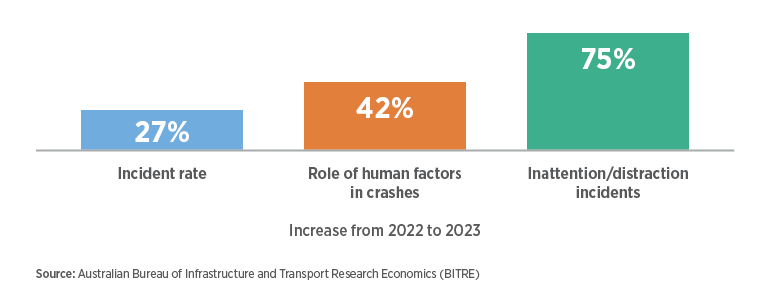
  • the overall incident rate in 2023 has increased by 27% since 2022, marking a concerning trend that has been accelerating since 2020
  • losses have risen across almost all cause codes, with crashes related to human factors increasing by 42% since 2022
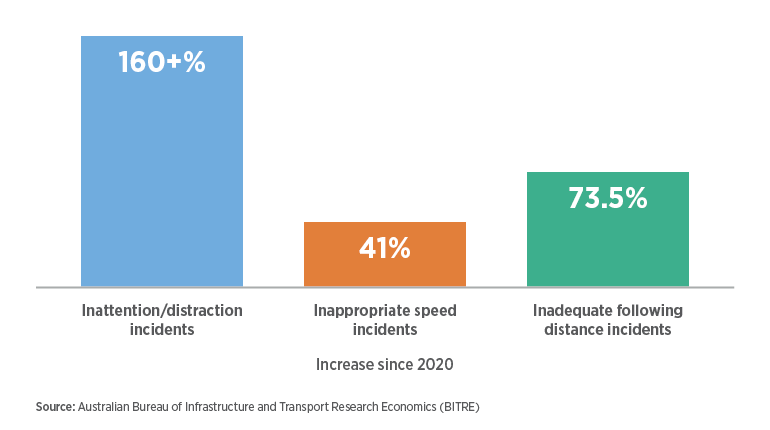
  • inattention/distraction incidents were the most prevalent cause in 2023, with incidents doubling the rate of any other cause and increasing 75% since 2022. Over the past five years, there has been a 2.6-fold increase — more than 160% — in these types of incidents
  • over five years incidents due to inappropriate speed increased by 41%. In 2023 89% of these incidents involved a single vehicle, with 85% resulting in vehicles going off the path on curves
  • inadequate following distance incidents have increased by 73.5% over five years. These incidents mainly resulted in collisions with the rear of third-party vehicles, occurring predominantly in major cities and involving heavy vehicles and cars travelling in the same direction.

What can trucking operators do to reduce risks?

One of the most important measures business owners can take is ensuring that work is assigned to appropriately qualified and experienced drivers.

The industry is heavily understaffed with severe shortages in all locations around Australia, with the result that some employers might assign a long haul to a newly licenced driver for lack of choice.

In terms of insurance cover, some insurers impose radius and age restrictions on the transport of certain types of goods, while other providers may simply require an additional excess.

Other risk management considerations include:

  • regular vehicle and equipment maintenance checks
  • upgrading equipment and technology, such as driver monitoring systems
  • comprehensive driver training and refresher courses
  • effective scheduling and enforced mandatory breaks.

Leverage transport insurance brokers for optimal insurance coverage

Partnering with an insurance broker who understands the trucking industry, key risk factors to mitigate and navigate insurer requirements is essential for securing a competitive insurance deal and gaining comprehensive coverage.

Avoid opting for the cheapest deal; adequate coverage is crucial. Gallagher's extensive experience in the heavy transport sector equips our brokers to offer precise guidance on policy coverage.

Reach out to explore tailored insurance solutions that align with your business needs and ensure robust protection.

connect with us


Sources

1 Road Trauma Involving Heavy Vehicles—Annual Summaries, Bureau of Infrastructure and Transport, Research Economics (BITRE), 18 Jan 2023

2 Major Incident Investigation Report 2024, National Truck Accident Research Centre (NTARC), 2024


Disclaimer

Gallagher provides insurance, risk management and benefits consulting services for clients in response to both known and unknown risk exposures. When providing analysis and recommendations regarding potential insurance coverage, potential claims and/or operational strategy in response to national emergencies (including health crises), we do so from an insurance and/or risk management perspective, and offer broad information about risk mitigation, loss control strategy and potential claim exposures. We have prepared this commentary and other news alerts for general information purposes only and the material is not intended to be, nor should it be interpreted as, legal or client-specific risk management advice. General insurance descriptions contained herein do not include complete insurance policy definitions, terms and/or conditions, and should not be relied on for coverage interpretation. The information may not include current governmental or insurance developments, is provided without knowledge of the individual recipient's industry or specific business or coverage circumstances, and in no way reflects or promises to provide insurance coverage outcomes that only insurance carriers' control.

Gallagher publications may contain links to non-Gallagher websites that are created and controlled by other organisations. We claim no responsibility for the content of any linked website, or any link contained therein. The inclusion of any link does not imply endorsement by Gallagher, as we have no responsibility for information referenced in material owned and controlled by other parties. Gallagher strongly encourages you to review any separate terms of use and privacy policies governing use of these third party websites and resources.

Insurance brokerage and related services to be provided by Arthur J. Gallagher & Co (Aus) Limited (ABN 34 005 543 920). Australian Financial Services License (AFSL) No. 238312