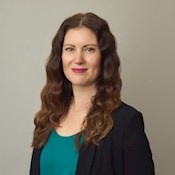
Author: Holly Samson
Since joining Gallagher in 2019, Holly has built a reputation for her thoughtful, people-first approach, combining deep technical expertise with a strong understanding of how business decisions play out in the real world. Whether advising on strategy or supporting clients through critical moments, Holly's focus is always on helping organizations move forward with clarity and confidence.
In one sentence, what do you do at Gallagher — and who do you do it for?
I work closely with leadership teams to help them manage risk around key decisions, protecting their executives and strengthening their overall resilience through tailored directors and officers (D&O) and executive risk strategies.
When do you feel like your work has the biggest impact?
I feel it most when I can help leadership teams move forward with confidence in tough or uncertain situations. With D&O, it's rarely just about placing a policy; it's about backing the people who are making difficult calls on behalf of their business, their employees and their stakeholders.
The best moments are when I can simplify something complex, whether that's guiding a client through a claim, pressure-testing their program or helping them secure coverage that supports their growth. I also find it rewarding when the conversation moves beyond pricing and toward broader risk strategy. When clients start to see the value in having a partner who understands what they're up against and can help translate that into real protection.
Internally, it's when I can help others feel more confident talking about management liability and raise the bar on how we approach executive risk as a team.
What's one thing that might surprise people about your job?
D&O insurance is often far more about people, strategy and psychology than it is about insurance itself.
It's a technical product, but the real work is understanding how leadership teams think and make decisions under pressure. Many conversations go well beyond insurance, into growth strategy, board dynamics, shareholder expectations and how organizations respond to moments of uncertainty.
Another thing that surprises people is how personal it becomes during a claim. For executives, reputation, career and personal liability can feel at stake, so the role shifts from salesperson to advisor and advocate very quickly.
It's one of the few areas where you're constantly sitting at the intersection of business strategy, legal risk, finance and human behaviour, which is what makes it so interesting.
What's one trend in your specialty that clients may not be paying enough attention to yet?
One trend I don't think is getting enough attention right now is how closely reputational risk and executive liability are becoming intertwined.
Not long ago, D&O claims were typically tied to defined events like securities actions, insolvencies or regulatory investigations. That's still true, but increasingly, exposures are emerging from issues that unfold quickly and publicly: cyber incidents, workplace culture concerns, ESG scrutiny, AI governance or a single decision that gains traction on social media.
What's really changed is the speed and visibility of stakeholder reaction. A leadership decision can turn into a reputational issue almost overnight, and that can quickly lead to regulatory interest, shareholder actions, employment claims or board-level scrutiny.
At the same time, the broader environment is adding pressure. Economic uncertainty, insolvencies, geopolitical tensions and an evolving regulatory landscape are making the job of directors and officers more complex than ever.
The organizations staying ahead are the ones that don't treat D&O as just another annual renewal, but as part of a much bigger conversation around governance, communication and risk strategy.
What questions are clients asking you most often right now?
Lately, almost every conversation is tied back to the same theme: uncertainty. Clients are trying to understand how today's environment is reshaping their risk.
Cyber is still front and centre, but it's no longer just, "Do we have coverage if something happens?" It's, "If leadership decisions around cybersecurity, privacy or AI adoption are challenged after an incident, are we exposed?"
What's also changed is the nature of the questions are less transactional and much more strategic:
- Are our limits still where they should be?
- How do we compare to our peers?
- What are underwriters really focusing on right now?
- Where are claims trending, and what does that mean for pricing and retentions?
- Are our governance practices helping or hurting us in the market?
In Canada there's also added focus on regulatory scrutiny, shareholder expectations and balancing growth with disciplined risk management in a slower economy.
The shift I've noticed most? The conversation is moving away from "What's this going to cost us?" to "How exposed are we, really?"
That's where the role becomes much more about advice than placement.
How has your role evolved over time?
It's changed quite a bit, and honestly, pretty quickly.
Ten years ago, a big part of being a broker was access to markets, information and capacity. Today, that's no longer the differentiator. Clients can pull up market data, pricing trends and general coverage insights in seconds.
Where we add value now is much more strategic.
The conversations I'm having now are less about placing a policy and more about helping clients understand how their risks are evolving, and how everything connects. Whether it's D&O, error and omissions (E&O) or cyber, it's about building a program that reflects how their business actually operates today.
And those risks are only getting more complex. Technology, cyber exposure, regulatory scrutiny, data and now AI don't exist in silos. They overlap, and that's where things can get missed if you're not looking at the full picture.
If anything, the human side of brokerage has become more important. Judgment, context, advocacy and being able to translate complexity into something practical, that's where clients still need a partner.
That's really how I see the role now: less transactional, more advisory and much closer to the business.
What has been the biggest learning curve in your career?
One of the biggest shifts for me was moving from underwriting into broking. Early in my career, I was very focused on a single line of coverage and learned to look at risk through a highly specialized lens.
Stepping into broking challenged me to zoom out. Instead of thinking about one policy at a time, I had to understand how D&O, E&O, cyber and other management liability coverages fit together across different industries, and how they support a client's broader business strategy.
It was definitely a learning curve, but it's also what's made the role so rewarding. Combining that technical underwriting foundation with a more holistic view of risk allows me to better support clients and collaborate more effectively with both underwriters and internal teams.
How do you keep developing your skills?
In this industry, standing still isn't really an option. The risk landscape is constantly moving.
For me, it starts with a genuine interest in understanding more. I make a point of keeping up with claims trends, regulatory changes and what's happening in the industries my clients operate in. Whether it's AI or shifting litigation patterns, there's always something new to understand.
A big part of my growth also comes from the people I work with. Collaborating with underwriters, claims professionals, coverage counsel and clients has given me a more complete view of how risk actually plays out in real time.
Working in management liability means you're always learning by default. The technical side is critical, but so is being able to translate complexity into something clear and actionable, and ideally, getting ahead of issues before they become problems.
For me, it comes down to staying engaged, asking good questions and continuously sharpening both the technical and advisory side of what we do.
What makes your team a great one to work on?
What makes my team great is how naturally expertise and collaboration come together.
Everyone brings something different to the table — whether it's product expertise, industry experience or claims insight — but there's a real openness in how we share that knowledge. In a space like management liability, where things evolve quickly and no one person has every answer, that kind of collaboration isn't just helpful, it's necessary.
There's also a genuine curiosity across the team. We challenge each other (in a good way), stay close to what's happening in the market and spend time thinking through how it all translates back to our clients. It keeps us sharp and constantly learning.
At the end of the day, it's an environment built on trust, where people want to get better and want to help each other get there. That's what makes the work both rewarding and energizing.
What motivates you when work gets challenging?
What motivates me when work gets challenging is a combination of professional purpose and personal perspective. I genuinely enjoy solving complex problems and being a trusted advisor during high-stakes situations. There's a real sense of responsibility and fulfillment in helping clients navigate through uncertainty and important business decisions.
Personally, my family and children are a huge source of motivation. They keep me grounded and give me perspective. They remind me why resilience, hard work and continuous growth matter. I want my kids to see that you can build a successful career while staying engaged, adaptable and committed to helping people. On difficult days, that balance between professional challenge and personal purpose is what keeps me moving forward.
What are you most proud of in your career so far?
One of the things I'm most proud of in my career is building it through consistency, resilience and hard work. As a woman in a highly competitive industry, I learned early on that preparation, focus and credibility matter, and that no one was going to do the work for me or advocate for me better than I could advocate for myself.
There were challenging periods along the way, but I'm proud of how I stayed focused, continued developing my expertise and pushed myself outside my comfort zone rather than waiting for opportunities to come to me. Over time, that helped me grow from a specialized underwriting role into a broader advisory position across management liability.
I'm also proud that I've been able to build a career that combines technical expertise, strong relationships and leadership while still staying authentic to who I am.
What advice would you give to someone starting their career?
Maintain an inquisitive mindset and remain open to new perspectives. Early on, it's natural to focus on building technical expertise, but what really sets people apart over time is how they pair that knowledge with strong relationships, clear communication and trust.
Don't shy away from opportunities that stretch you. Some of the most meaningful growth comes from stepping into areas where you're not fully comfortable yet. For me, that meant expanding into other lines and across different industries, which ultimately shaped how I approach risk and problem-solving today.
I'd also emphasize the importance of authenticity. Be yourself, be genuine in how you show up and don't feel like you need to have all the answers early on. People gravitate toward those who are transparent, consistent and sincere; it goes a long way in building lasting professional relationships.
And maybe most importantly, remember this is a long game. Careers aren't built overnight. The people who stand out are the ones who keep learning, stay curious and consistently show up as thoughtful, reliable and solutions-oriented partners.