Employee benefits have never been more important, or more underutilised. Despite years of investment, employers still struggle to connect people with the right support at the right time. It's not solely about what’s offered, it’s about how employees find and use those benefits when they need them most.
Getting your Trinity Audio player ready...

Authors: Alex Dunning Ben Warren

null

Why benefits matter and why they’ve been falling short

At their best, benefits are designed to support employees through major life moments: growing families, financial uncertainty, illness, or mental health challenges. But historically, the delivery of these benefits has been reactive, complex, and disconnected from the real-world needs of the people they’re meant to serve.

Key challenges include:

  • Underutilisation of resources, especially in mental health, where stigma and confusion block access
  • Overlapping provisions across insurance and support services, leaving employees unsure where to turn
  • Poor timing, with support often centered around annual enrolment, rather than everyday moments that matter

Meanwhile, costs continue to rise – particularly for healthcare-related benefits – prompting HR teams to justify spend without a clear way to demonstrate impact.

The shift: From offering benefits to navigating them

The real transformation lies not in adding more benefits, but in helping employees understand and use what’s already there, creating a compelling Employee Value Proposition. That’s where benefits technology comes in.

Modern platforms now go beyond enrollment tools. They serve as active guides, helping employees navigate complex decisions throughout the year - not just during selection windows. Think of it as moving from:
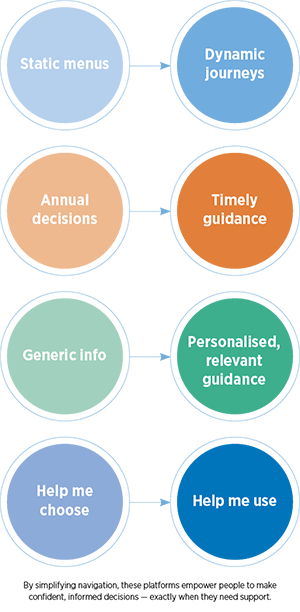
Real-world example: Untangling complexity

Take a common case: an employee dealing with persistent back pain. Without guidance, their instinct may be to submit a costly claim through private medical insurance (PMI). But a smart benefits platform could suggest National Health Service (NHS) physio options first, or flag employer-provided resources like ergonomic assessments or income protection support. The outcome? Faster care, reduced cost, and a more appropriate use of resources, for both the employee and the business.

The AI advantage: A smarter, more personalised experience

Adding AI to the equation unlocks even greater potential, increasing personalisation and recommendations, and driving better benefit utilisation and business ROI as a result. But AI alone isn’t enough - context matters. When tech is designed without human expertise, it risks becoming just another chatbot spitting out generic advice.

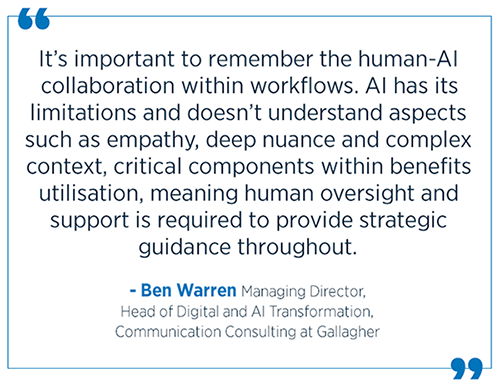
Ben Warren, managing director, head of Digital and AI Transformation, Communication Consulting at Gallagher, observes that: “The technology is already available through the streamlining of admin tasks and automation of repetitive actions such as processing claims, compliance checks or supporting communications. However, the business culture and management of change is playing catch up to the technology and so the power lies in combining AI with specialist consulting insight.” This means systems that:

  • Deliver recommendations based on real-life employee needs and benefit logic
  • Understand the nuance between overlapping policies and support services
  • Learn and adapt to employee behaviours and preferences over time

For example, AI can detect when an employee might be approaching burnout and proactively prompt relevant wellbeing tools before a crisis hits. It can also tailor communications to suit neurodiverse employees or those who prefer visuals over text. These are not future hypotheticals, they’re happening today.
The Future of Benefits Navigation: Merging Digital with the Human Experience

Tangible business impact

Smarter benefits navigation doesn’t just improve experience, it drives real results:

  • Easier access to the right support improves wellbeing outcomes
  • Greater confidence in using benefits builds trust and engagement
  • Personalised guidance signals that their employer genuinely cares
  • Better benefit utilisation improves return on investment
  • Streamlined navigation reduces unnecessary or misdirected claims
  • Freed-up HR time can be redirected to strategic priorities
  • Enhanced experience supports recruitment and retention goals

It’s not about adding complexity - it’s about removing it.

Looking ahead: What’s next for benefits tech?

Despite considerable investment in benefits technology, a significant gap remains. According to our latest Benefits & Benchmarking Survey, 56% of UK employers say their employees are not actively engaging with the platforms in place. This disconnect can lead to lower employee engagement, retention issues, and inefficient use of resources.

We’re just scratching the surface. The next evolution will see benefits platforms become proactive wellbeing partners—anticipating needs, not just reacting to them.

Emerging innovations include:

  • Predictive models that flag when employees may soon need support
  • AI copilots for HR teams that recommend optimal interventions as well as benefit design and benchmarking, hyper-personalised and proactive wellness and preventative care
  • Adaptive experiences that adjust to language, tone, and accessibility preferences
  • Integrated ecosystems that connect seamlessly to NHS services, financial tools, and more

The goal isn’t to replace humans, it’s to extend their reach and ensure support is always timely, relevant, and accessible.

As Ben Warren notes: “Despite a proliferation of tools and growing investment, AI adoption is still largely concentrated in IT and marketing. That leaves a major opportunity for HR to close the gap—using AI not just to streamline tasks, but to amplify impact and reduce business risk.”

Despite considerable investment in benefits technology, a significant gap remains.

According to our latest Benefits & Benchmarking Survey, 56% of UK employers say their employees are not actively engaging with the platforms in place. This disconnect can lead to lower employee engagement, retention issues, and inefficient use of resources.

Gallagher offers a better way forward.

Introducing Gallagher Guide — our human-centered benefits platform that pairs powerful technology with expert consulting to help HR lead with clarity and purpose, while enabling employees to truly engage with their benefits.

  • Simplified administration, smarter insights: Scalable tools with real-time analytics that enable quick, informed decision-making.
  • Designed for people, not just processes: A personalised and intuitive user experience that empowers employees to understand, select, and appreciate their benefits.
  • Consulting that adds value: Our experts combine empathy with strategic thinking to turn your digital tools into real-world impact.
 

The right technology is just the beginning. Lasting impact comes from combining smart tools with human insight to elevate the employee experience.

Gallagher’s 2024 Workforce Trends Survey was conducted 23rd April to 9th July 2024 among 236 UK organisations.

Cultural change starts now

Technology can guide and scale support, but culture is what drives trust. As digital-native employees bring expectations of personalised, intuitive experiences to the workplace, HR must evolve to meet them.

That means:

  • Designing benefit experiences that centre around navigation—not just provision
  • Embedding empathy and inclusion into every stage of the employee journey
  • Reframing benefits as foundational to wellbeing, productivity, and culture—not just “extras”

This shift positions benefits not just as a cost centre, but as a strategic enabler of business performance and employee loyalty.

We’re entering a new era where employee benefits are no longer defined by what’s offered, but how effectively those offerings are delivered and used. With the right technology, grounded in human expertise and powered by AI, organisations can finally fulfil the original promise of benefits: timely, meaningful support that improves lives and drives business success.

Author Information

Alex Dunning

Alex Dunning

Senior Consultant


Disclaimer

Gallagher’s 2024 Workforce Trends Survey was conducted 23rd April to 9th July 2024 among 236 UK organisations.