
Gallagher, the global insurance brokerage, risk management and consulting firm, has unveiled the results of its global supply chain research report, providing a comprehensive view of the concerns, strategies, and risk management needs of business leaders in today's uncertain world.
Supply Chains, Redrawn: Lessons from Business Leaders Across Industries is informed by views from company directors representing seven countries, across a broad cross-section of business sizes and industries, who were surveyed to assess the concerns, risk mitigation tactics, and risk management needs that currently shape their supply chain strategies.
Many underinsured for supply chain disruption that has marked past five years
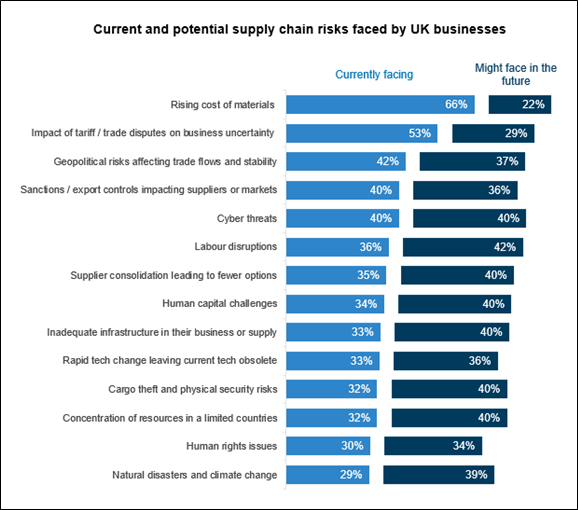
Over a quarter (29%) of respondents in the UK agreed that supply chain disruptions have worsened in the past five years, with two-thirds of respondents citing the rising cost of materials as the most widely faced supply chain risk currently posed to firms operating in the UK.
The impact of tariff and trade disputes on business uncertainty (53%) and geopolitical risks affecting trade flows and supply chain stability (42%) were the second and third biggest risks impacting successful trading. Cyber threats (40%), export controls impacting suppliers or markets (40%), and labour disruptions (36%), also all placed highly as risks currently faced.
Of those who experienced supply chain losses in the last 12 months, just under half (46%) of UK businesses had insurance in place to fully cover losses, leaving many firms facing potentially substantial costs to bear. Although the UK figure still demonstrates extensive underinsurance against supply chain risks, the UK figure was significantly higher than 32% of all global respondents.
Looking forward: Economic and geopolitical factors to fuel structural instability
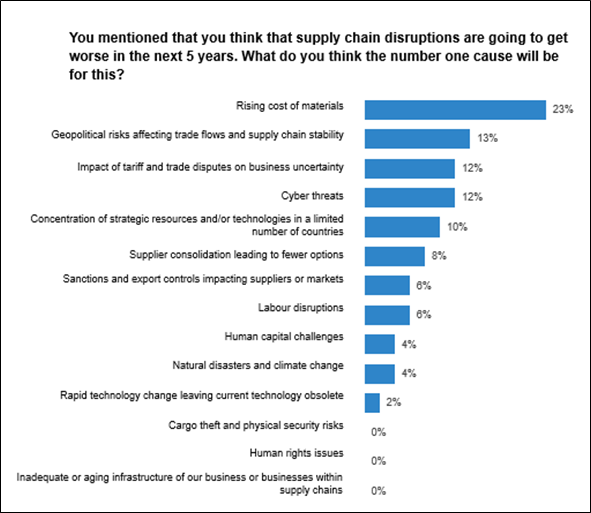
Around one in five respondents in the UK (19%) predict that supply chain disruptions will worsen in the next five years with the top cause identified as the rising cost of materials (23%). Once again, the impact of political and economic developments featured heavily, with 13% of respondents stating that geopolitical risks affecting trade flows and supply chain stability would be a top cause of further disruption, while the same proportion also identified the impact of tariff and trade disputes on business uncertainty. Further factors are outlined in the chart below.
Source: Gallagher.
Supplier consolidation, labour disruptions, and cargo theft identified as top future risks
Labour disruptions top UK business leaders' concerns, with 42% stating that they may face this as a supply chain risk in the future. Interestingly, business leaders in the UK expect the impact of tariff and trade disputes to wane, with it being ranked as the second least likely risk to be faced in the future (29%) — this is despite it being the second most widely faced current supply chain risk with 53% of respondents affected.
Source: Gallagher.
Business executives exploring supplier diversification, onshoring and nearshoring, and digital tools to manage future risks
Over two-thirds (68%) of UK business executives are investing in technology — specifically digital tools, AI, or monitoring systems — to help improve oversight and responsiveness and help manage supply chain risks. The majority are also looking to alter supplier relationships in some capacity, due to past, current, and predicted future disruption. 64% are diversifying suppliers used, while 66% are also exploring new partnerships (including long-term partnerships, closer supplier collaboration, and/or industry alliances).
61% also confirmed that they are adopting onshoring, nearshoring, or friendshoring to help manage the supply chain risks currently impacting their business, underscoring the concern around geopolitical developments.
Insurance brokers playing a vital role in mitigating supply chain risk
Looking at the vital role that insurance plays in helping businesses manage supply chain risk, 39% of business executives agreed that flexible insurance products that adapt to changing risk profiles would be beneficial. Similarly, a third of business executives also agreed that tailored risk assessments specific to their individual supply chain vulnerabilities would help, highlighting the importance of engaging with intermediaries to arrange protection.
To access the full report, including data breakdowns by industry and geographic region, please click here.
Neil Hodgson, Managing Director of Risk Management, Gallagher, said: "Supply chain disruption significantly impacted the way that the world conducted business last year, with climate change and geopolitical conflict acting as two key contributors. The notable increase in cyberattacks was perhaps the most unprecedented factor, with UK businesses among those which suffered huge losses. Indeed, the National Cyber Security Centre reported that the UK suffered four 'nationally significant' cyber-attacks every week in the year to September, up by 129% against the year prior1.
"After a year fraught with operational challenges, UK business executives are now more acutely aware of the scale and range of risks at hand, and yet many businesses remain critically underinsured. Indeed, less than half of UK-based respondents whose businesses suffered supply chain loss in the last year had their losses fully covered by adequate protection.
"With global concern around further supply chain disruption remaining high, business executives should speak to a risk management advisor to help them address the protection gap that left many firms vulnerable to losses last year. Brokers play a key role in delivering tailored risk assessments that identify each business's specific supply chain vulnerabilities and sourcing comprehensive risk management and insurance products."
