
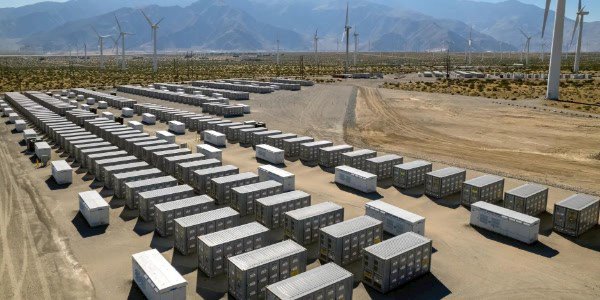
Beyond the battery hardware, facility layout plays a major role in risk mitigation. How you arrange Battery Energy Storage System (BESS) units on a site can affect both the probability of fire spread and the ability to respond if an incident occurs. Large-scale fire test results are encouraging — they suggest that even tightly clustered battery containers might not propagate fire as previously feared. However, prudent site planning still incorporates defensive spacing and other measures as safeguards.
Spacing between battery units
Industry best practices (and many local fire codes) call for clearances around BESS enclosures. Wärtsilä, a global leader in innovative technologies for energy markets, recommends approximately 10 feet between containers for ease of maintenance and to ensure workers and firefighters can move around safely. Our firm concurs that maintaining an aisle not only facilitates access but also provides a heat buffer. Even though tests showed no ignition in a container eight feet away, that gap helped keep radiant heat off the target unit's surface.
We interpret the data to mean you don't need excessive separation to prevent fire spread — which is good news if land is limited or if you want to pack more megawatt-hour per acre — but you also shouldn't eliminate spacing entirely because of practical response needs. The test's evidence of no propagation at a 6-inch distance was specific to having robust firewalls in place — effectively, the container design acted as a built-in fire barrier. If your project uses different container technology or a vendor with less fire testing, we might advise greater separation until equivalent safety can be proven.
Battery orientation and layout
Orientation and layout are another consideration. Deflagration vents, for example, should ideally point away from adjacent assets — typically upward or toward a safe exclusion zone. In site design, we ensure that if one unit vents flames, it won't impinge on another unit's intake vents or combustible equipment nearby. The 4-megawatt-hour test had vents on top of doors; in a real installation, we'd want to know whether those doors face open space or the next container. Such details can decide whether a self-venting container truly protects its neighbor.
Our risk engineers collaborate with facility planners to review battery yard layouts, checking for adequate distances not just between batteries but also from transformers, control rooms, property fences and any public areas, as required by standards such as the National Fire Protection Association (NFPA) 855, which is the key fire code for energy storage.
We also factor in the following:
- Wind direction that could blow flames or hot gases toward other equipment
- Drainage for firewater runoff if firefighters hose down a unit
- Compartmentalization with fire-rated walls or partitions if multiple units are in a building
Code compliance
Importantly, code compliance is evolving alongside new test data. The upcoming 2026 revision of NFPA 855 is expected to incorporate large-scale fire testing requirements, essentially mandating that vendors demonstrate containment performance.
Our team stays ahead of these changes. We actively use findings like "no propagation to adjacent units" to advocate for code allowances that maintain safety without overburdening projects. For instance, if evidence shows an 8-foot aisle is sufficient, we might help a client make the case to authorities having jurisdiction (AHJs) that their design meets intent, potentially avoiding costly retrofits or excessive separations. On the flip side, if a project's batteries haven't undergone such robust testing, insurers and regulators may require more conservative measures — and we'll guide you on how to comply or whether to seek out a better-tested solution.
Emergency response planning
Finally, emergency response planning is a vital aspect of site safety. Containing a fire is one thing; communicating and coordinating with first responders is another. We leverage test insights, such as how long a container can burn (up to nine hours in the Wärtsilä test) to inform fire department pre-plans.For example, if a BESS might burn itself out without spreading, the strategy for firefighters could be defensive: protect exposures and let it burn.
We ensure our clients have clearly defined protocols with local fire services and that features like remote monitoring, manual emergency stop systems and firefighter access doors are all accounted for in the design. Our technical knowledge helps bridge the gap between what the battery system is engineered to do and what emergency crews expect on the ground.
VIEW AS PDF