

Getting your Trinity Audio player ready...
null

Every day, employees balance personal health decisions with financial realities — often quietly. But what if cost optimization wasn't just about cutting? What if it was about caring smarter, supporting better and creating lasting value for both people and organizations?

With rising healthcare costs, employers can't afford to choose between cost savings and employee wellbeing — they must go hand in hand.
Healthcare expenses are the #1 source of life stress for US employees1

Healthcare expenses are rising faster than wages2

51% of employers rank managing healthcare costs among their top 5 wellbeing objectives for 20253

Achieve cost savings and employee wellbeing with a holistic approach

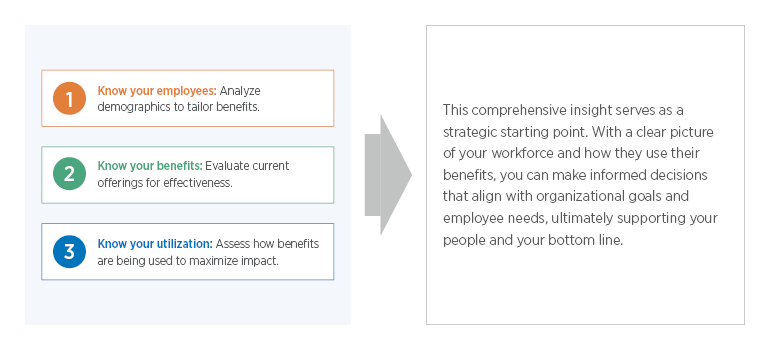
Know your employees, your benefits and your benefit utilization as a starting point.

Reduce financial strain with proactive voluntary and pharmacy strategies

Integrated voluntary benefits: More value, less cost

  1. Combine for coverage discounts: Bundling core and voluntary benefits such as life, disability and accidental can lead to savings for both employers and employees. Employers receive discounts on core coverage, while employees enjoy group rates on supplemental health plans.
  2. Streamline claims: Auto notification or adjudication simplifies claim management, reducing administrative burden and boosting employee utilization. Integrated plans often offer streamlined and potentially higher payouts compared to standalone strategies.
  3. Gain a market advantage: Carriers offer competitive rates by sacrificing some profit to gain greater market share, leveraging synergies with benefits.

Proactive pharmacy strategies: Reduce financial strain

  1. Leverage biosimilars for savings: With 69 approved biosimilars,4 employers can offer substantial cost reductions by offering lower-cost alternatives to brand-name drugs.
  2. Navigate co-pay and patient assistance programs: As employees face higher out-of-pocket costs under high-deductible health plans (HDHPs) and co-insurance plans, co-pay and patient assistance programs can help manage healthcare expenses, despite administrative challenges.
  3. Evaluate broader use of GLP-1s: Consider the pros and cons of covering weight loss medications, including costs and qualification criteria. A thoughtful utilization management strategy can encourage lifestyle changes and support long-term health — while also helping manage conditions like diabetes and heart disease to reduce overall healthcare costs.

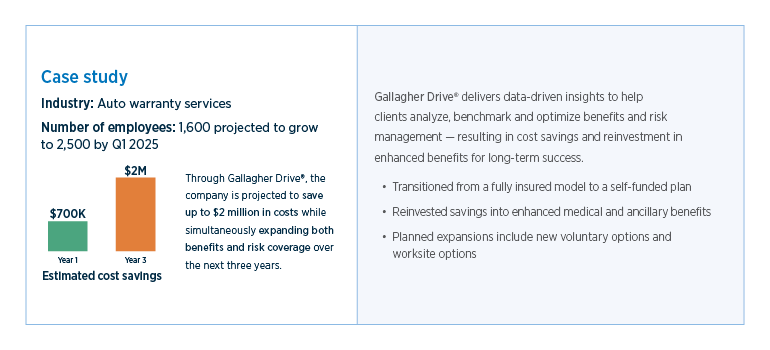
Saving $2M in costs: A closer look at client outcomes

Case study of auto warranty services company; projected savings of up to $2 million

Balance healthcare costs while enhancing employee engagement. Contact your Gallagher consultant today.

View as PDF

Sources

1Rakshit, Shameek et al. "How Does Medical Inflation Compare to Inflation in the Rest of the Economy?" Peterson-KFF Health System Tracker, updated 2 Aug 2024.

2White, Alexandria. "73% of Americans Rank Their Finances as the No. 1 Stress in Life, According to New Capital One CreditWise Survey," CNBC, updated 28 Feb 2025.

3Organizational Wellbeing Poll, Gallagher, Jan 2025.

4"Biosimilar Product Information," FDA, updated 25 Mar 2025.


Disclaimer

Consulting and insurance brokerage services to be provided by Gallagher Benefit Services, Inc. and/or its affiliate Gallagher Benefit Services (Canada) Group Inc. Gallagher Benefit Services, Inc. is a licensed insurance agency that does business in California as "Gallagher Benefit Services of California Insurance Services" and in Massachusetts as "Gallagher Benefit Insurance Services." Neither Arthur J. Gallagher & Co., nor its affiliates provide accounting, legal or tax advice.