Impact of pay practices on wage increases
Healthcare wage increases in 2025 exceeded projections by 1% to 1.5%, according to a Gallagher pulse survey. The HR team's ability to help the organization's leaders understand the disconnect between projected and actual wages will support better strategic planning about compensation resources.
Multi-layered pay practices, such as shift and specialty pay, often drive unplanned wage increases. While essential for staffing, these practices introduce complexity and cost pressures.
However, when structured effectively, such pay practices can help manage spending. Awareness of pay practice trends ensures the most effective use of compensation strategies in service of organizational goals.
Survey findings: Key healthcare pay practices and trends
Shift differentials
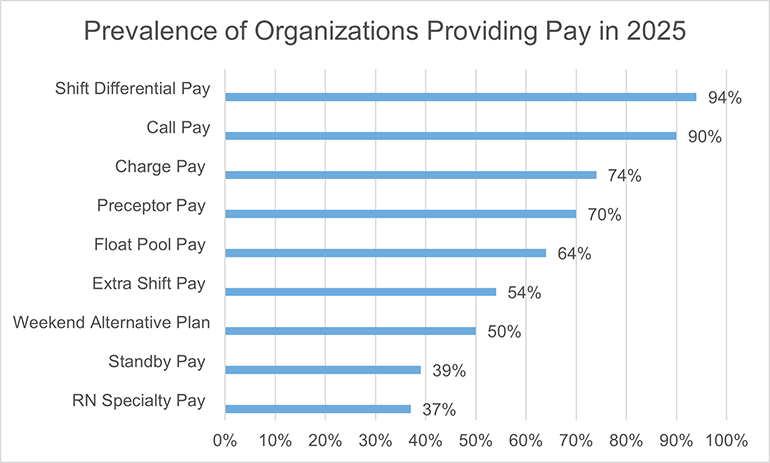
Staffing for a 24/7 environment demands use of differential pay, with 94% of organizations providing additional pay for night shifts and more than half offering pay for evenings and weekends. Most organizations use flat-dollar amounts rather than percentage differentials to avoid inflationary costs when wages increase. Differentials tend not to increase at the same rate as base wages in the market and should require review only every few years.
Call and standby pay
Most organizations (92%) provide call pay for employees required to serve on-call, while 40% offer pay for those on standby. For call pay, 62% of organizations pay 1.5 times the employee's base rate, typically guaranteeing two hours of pay. Exempt employees are ineligible for call pay in 60% of organizations.
Charge and preceptor pay
A majority (74%) of organizations provide charge pay to employees in lead positions during shifts, while 70% offer preceptor pay to those training new employees. More than 90% use flat-dollar differentials for both practices.
Float pool pay
Nearly two-thirds of organizations use RN float pools to maintain staffing levels, with 77% offering flat-dollar differentials — typically $4 per hour. About half reported multiple pay levels in their float pools, varying by acuity, experience and/or specialty.
Extra shift pay
About 54% of organizations surveyed provide extra pay to employees working additional shifts, according to our recent pulse survey. Most (40%) offer flat-dollar differentials, while 34% provide per-shift bonuses.
Hourly extra shift differential pay for RNs increased by 50% from 2020 to 2022; however, differentials now are trending back toward pre-pandemic levels as organizations tighten their use of extra-shift programs.
Weekend alternative programs
Half of survey participants use weekend alternative programs, primarily for nursing staff but also for lab positions, surgical technicians, respiratory therapists and social workers. Most (49%) offer flat-dollar differentials, requiring employees to work 24 hours per weekend, offering four weekends off annually.
Registered nurse specialty pay
Additional pay for registered nurses (RNs) in such specialty areas as the emergency department (ED), operating room (OR) and critical care has fluctuated since 2020, declining slightly in 2025. Among organizations offering RN specialty pay, 42% use higher pay grades, 45% use flat-dollar differentials, and 18% use percentage differentials — a declining practice. Specialty pay occurs most commonly in OR (60%), cardiovascular ED (51%) and ED (44%).
However, organizations increasingly are discontinuing these programs in the face of enforcement challenges and higher costs.
Bonus and other incentives
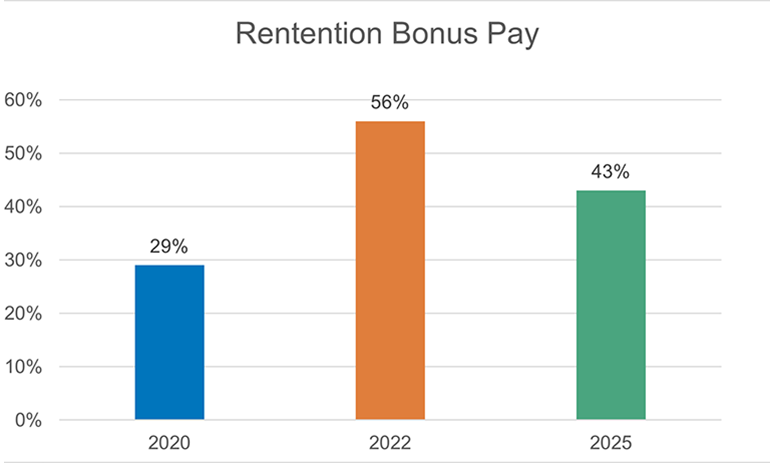
Hiring and retention bonuses gained traction during the pandemic. While hiring bonuses remain popular, use of retention bonuses has declined from 56% in 2022 to 43% in 2025. Other financial incentives include performance, tenure, certification bonuses, group incentives and gainsharing plans. These plans allow staff to share financial savings achieved through improved efficiency, quality or cost reduction without compromising patient care.
Of note, 40% of organizations offer no additional incentives. Such incentives are culture-driven and don't necessarily represent a competitive advantage or disadvantage.
Gallagher can help
Pay structure options represent valuable tools for rewarding employees and managing labor costs. Gallagher's healthcare compensation team can help your organization proactively identify the right mix of tools specific to your local or regional market to help avoid off-cycle wage increases that consume significant HR and financial resources.
Watch this webinar on demand for additional insights into healthcare pay practices and salary administration guidelines.
CONTACT US