Author: Tom Wardrip

Costs of health plans and medical plans continue to climb. In Gallagher's 2025 Benefits Strategy and Benchmarking Survey, more than 21% of the 3,400+ organizations responding reported controlling employee benefit costs as a top operational priority.
Beyond the usual approaches at renewal time, some organizations have chosen to reduce their cost by introducing alternate methods for employee contribution levels.
Source: Gallagher's 2025 Benefits Strategy and Benchmarking Survey
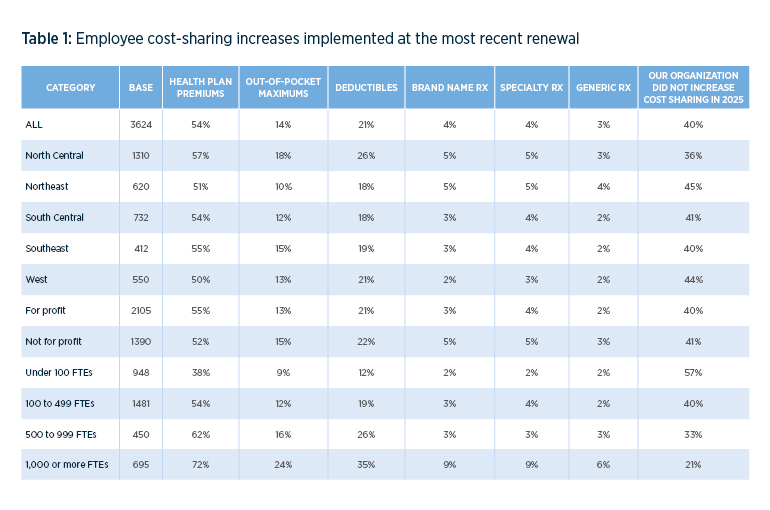
As Table 1 shows, many organizations implemented increases to various components of employee cost-sharing at the most recent renewal. At the same time, other organizations didn't increase employee cost-sharing in 2025.
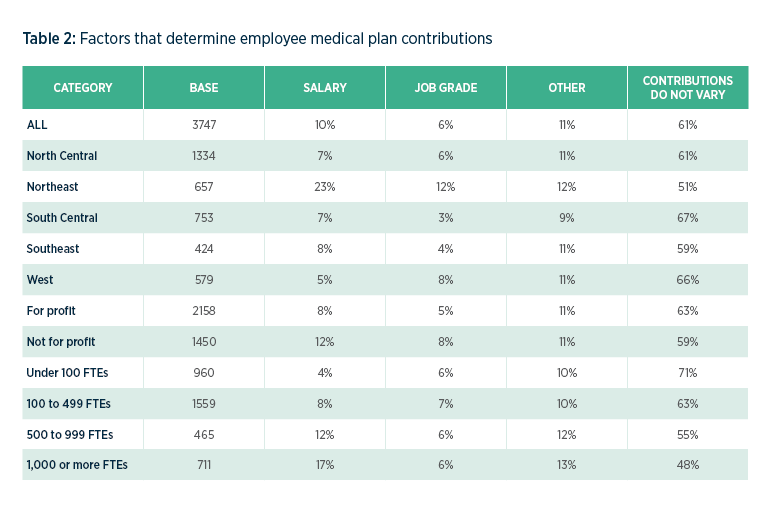
Gallagher surveyed employers to find out what factors they use to determine employee medical plan contributions. More than 61% don't vary the employee contributions. Of those that do vary employee contributions, 10% of employers nationally base the variation on employee salary (Table 2). The practice appears to be more common in the Northeast and in organizations with at least 1,000 full-time employees (FTEs).
Source: Gallagher's 2025 Benefits Strategy and Benchmarking Survey
Typically, employers assign groups of salary thresholds to certain employee contributions. Each organization manages different medical plan costs and must determine to which costs, if any, they wish the employee to contribute.
57% of organizations nationally report the highest enrollment in preferred provider organization (PPO) plans. Within those plans, 87% of organizations ask their employees to contribute to the premium cost of the plan. The median employee contribution is 20% for individual plans and 28% for family plans.
Cost sharing contributions may risk pay equity and employee engagement concerns
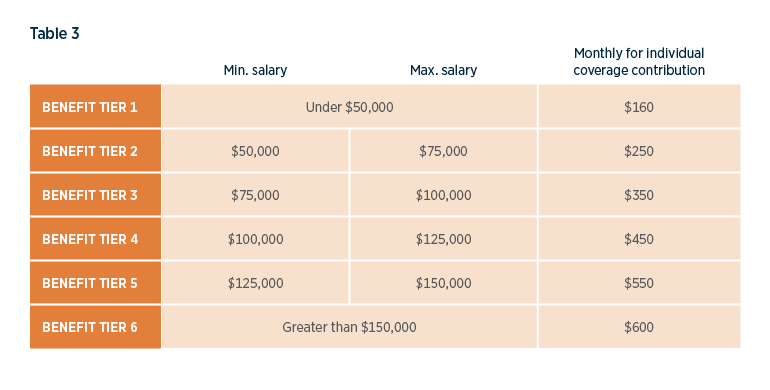
Table 3 shows a medical plan employee cost-sharing contribution by salary level. The organization represented chose to segment the employee contributions by salary level, with the lowest tier below $50,000 and the highest tier above $150,000.
Such a program aims to alleviate some of the pressure on the lower-paid employees and push more of the cost burden to the higher-paid employees, while minimizing the additional cost to the organization. Alternatively, the organization could choose to cover 100% of the medical plans and remove any employee contributions.
Source: Typical client data based on consulting experience
While such program designs are allowed, they carry potential pay equity and employee engagement risks. No matter how you slice the tiers, employees may bump up to a new tier with a pay increase. That situation can be very deflating for those receiving an increase only to find they take home less money. Many employees have shared this problem with us in our benefit-preference survey projects. Employers often overlook this problem when planning for benefit renewals.
As a further concern, pay increases under a tiered income contribution plan create the potential for employees in the same job to take home different levels of pay based on where they fall in the pay range.
Our team has yet to see this concern brought up concerning pay equity, but we anticipate it may arise in the future.
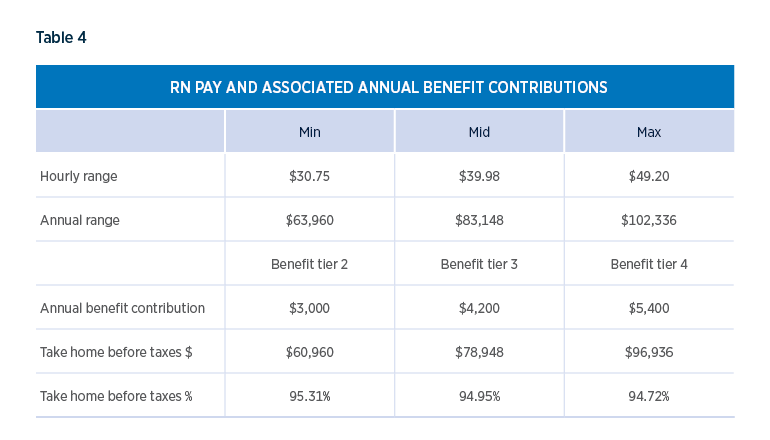
Using existing registered nurse salary ranges from a Midwestern healthcare employer, Table 4 shows how three registered nurses could find themselves paying substantially different cost-share contributions.
Source: Typical client data based on consulting experience
Pay-equity and career advancement messaging and protected class concerns
A nurse paid at the top of the grade range would pay $2,400 more per year for medical benefits than a nurse paid at the bottom of the grade range. These variances could increase substantially based on individual and family coverage choices. An employee may ask, "Is it fair to make a more experienced registered nurse pay $2,400 more for medical benefits than a peer doing the same job earning lower pay?"
What if that nurse is female, over 40 years old or non-white? An hourly difference in pay of a few pennies could cause thousands of dollars of impact on individuals in protected or unprotected classes.
Consider what message you're sending to employees about advancing their careers: "Work harder, get promoted, take home a lower percentage of your pay."
Align health plan benefits with existing job architecture
A fairer approach would be to align jobs with the benefit tiers based on existing job architecture. This approach uses defined job families and, for example, would align service workers to benefit tier 1, clinical workers to benefit tier 2, office professionals to benefit tier 3 and management to benefit tier 4.
Organizations that haven't yet created job architecture alternatively may align benefit tiers by pay grade, FTE status or even job title. The last option would have all registered nurses contribute the same dollar amount for their medical benefits, regardless of their salaries.
Jobs with wide pay grade ranges face potentially more pay equity and employee engagement risk than organizations using well-defined, market-appropriate grade ranges in a salary-based tier contribution system. If organizations are unsure whether their pay-grade ranges are appropriate, such employers may want to consider a compensation assessment before implementing changes to medical plan cost-sharing contributions.
Organizations that take the time to understand the potential impact of various medical plan cost-sharing approaches can avoid substantial headaches. Savvy organizations will look for small improvements to their overall total rewards programs wherever they can to compete more effectively for talent.
Gallagher can help
Gallagher can provide medical plan cost-sharing modeling, impact and strategy consulting as part of your Total Rewards philosophy and administration. Let Gallagher help you align your compensation and benefits with your strategic goals.
CONTACT US