Author: Peter Persuitti

Nonprofits exist to help address society's most pressing challenges, including homelessness, food insecurity and youth protection, as well as neuro-diverse and mental health support. That mission-driven purpose draws talented and passionate people to the sector.
"Nonprofits offer a uniquely rewarding work environment that keeps staff and volunteers motivated," observes Peter Persuitti, global managing director, Religious and Nonprofit practice, Gallagher.
Today's economic headwinds are testing that commitment. Nonprofit-specific data from Gallagher's Organizational Wellbeing Poll conducted in September 2025, highlights how organizations are adapting to these pressures — and the most effective choices that are emerging.
Examining the core: Efficiency and operational excellence
Economic pressures — such as reduced government funding, donors becoming more selective and increased competition for talent — have divided nonprofits into two distinct camps. According to the poll, while many reported negative economic impacts and responded with panic-driven cuts, others pivoted toward innovation:
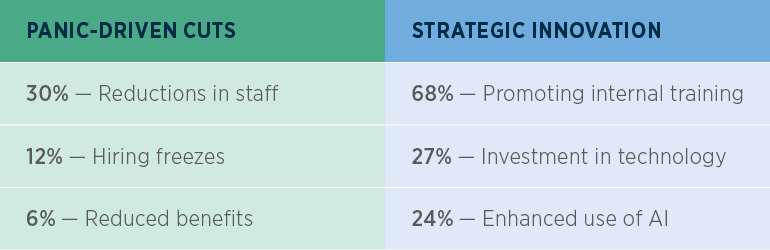
Forward-thinking nonprofits are strengthening their foundations. They're building capacity during challenging times, which requires intentionality in the development of people and leveraging of technology — strategies that drive resilience and long-term sustainability.
As Persuitti puts it, "This approach isn't just smart management — it's the contrast between organizations that merely survive difficult times and those that emerge stronger. When you invest in your people and their tools, you build the base for lasting impact."
Technology as a force multiplier
Nonprofits are leveraging technology to do more with less. Digital platforms and online fundraising expand global reach, while AI streamlines administrative work, allowing staff to focus on direct service.
The key lies in implementation. When done well, technology augments human roles and strengthens capabilities. Gallagher's annual survey on AI adoption found that 42% of leaders report that AI enhances positions when paired with proper training and change management.
Implementing technology requires upskilling and protecting the workforce. The same research shows nearly half of organizations offer training on AI tools, while 85% build job protection directly into their adoption frameworks. The result: Technology amplifies what staff can accomplish, enabling nonprofits to expand their impact without increasing their budgets.
Strength comes from partnering
Effective adaptation also requires recognizing interconnection.
"Nonprofits don't operate in isolation but as part of a broader ecosystem," Persuitti says. "Organizations that thrive are those that actively connect with others — whether to achieve their mission, find talent or share resources."
This ecosystem approach opens pathways that isolated organizations can't access. Within the sector, collaboration on shared resources and insurance pooling creates economies of scale, allowing nonprofits to collectively negotiate better rates and share risk.
Gallagher's poll of organizational wellbeing of nonprofits shows that 13% are already partnering with educational institutions to build talent pipelines, while others are joining up to share back-office functions or fundraising efforts.
Beyond the interaction in the sector itself, partnerships create additional value. Corporate alliances provide philanthropic funding and business knowledge that strengthen operations. Collaboration with local authorities enhances community safety efforts, particularly important for organizations serving vulnerable populations.
Investing in people
Nonprofits deliver impact through human connection, making workforce wellbeing a mission-critical priority. Although 75% of entities report higher stress and burnout, 65% cite increased workload due to staff shortages and 50% face talent retention challenges, there's clear momentum toward solutions.
More than half of nonprofits are looking into implementing financial wellness tools, 45% want on-demand mental health support, and 39% are exploring voluntary benefits. In fact, organizations are increasingly taking a whole-person approach to health and wellbeing, recognizing the urgent need to address the effects of stress factors on individuals and their impact on overall organizational resilience. Research has shown that:
- Programs for health and wellness that encompass physical, mental, social, and financial dimensions as interconnected factors reduce emergency healthcare costs.
- Organizations that prioritize early intervention and actively work to reduce stigma around mental health tend to see a higher frequency of cases but lower overall insurance claim costs.
Persuitti notes that comprehensive wellness support matters to younger generations that are naturally drawn to nonprofit missions but also expect holistic benefits, including nutrition and fitness support, as well as preventive care and mental health resources. Organizations that invest in these areas can attract and retain focused talent.
But wellbeing is only part of the equation. The poll shows 39% of nonprofits are upskilling their staff and 27% are enhancing training programs to strengthen recruitment, signaling a commitment to building employee development as a core strategy. Career growth remains a leading driver of engagement and retention.
Nonprofits are responding by creating clear career pathways that help employees envision their future, investing in learning and development programs to build skills and leadership and promoting internal mobility.
Strategic cost management through transparency
Transparency in financial decision-making is fundamental for nonprofits managing expenses while remaining competitive for talent. As organizations invest in people and technology, openly evaluating costs becomes essential.
Healthcare benefits, one of nonprofits' largest expenses, illustrate this challenge clearly. The poll shows 61% are concerned about maintaining health plan affordability, with two strategies emerging: 52% are exploring vendors or carrier changes to leverage market competition, while 29% are considering increased employee cost-sharing. The choice matters because one approach may protect talent while the other risks undermining it.
Persuitti is clear on which path offers better results. "Rather than reducing benefits when already struggling to attract talent, create competition by soliciting proposals from multiple carriers. This allows organizations to access better pricing and terms rather than shifting costs to employees."
Working with specialized brokers helps navigate these decisions effectively. "Organizations benefit from benchmarking data and guidance on nonprofit-specific insurance challenges, from liability concerns in foster care to professional risks in behavioral health services," Persuitti notes. "This makes it possible to control spending strategically rather than reactively."
Mission-driven organizations have always demonstrated resilience because they're built to address with purpose. By staying true to this while embracing innovation and partnership, they'll not only survive today's challenges but also emerge stronger and ready to expand their impact in the communities they serve.