Author: Priya Cherian Huskins
On December 10, 2025, Woodruff Sawyer, a Gallagher company, hosted its fifth annual State of the Economy and Capital Markets webinar. The news was good: a recession isn't expected in 2026. Nasdaq's chief economist expects the "Goldilocks" economy of 2025 to continue, a view supported by easing inflation, a relatively healthy labor market and a positive growth forecast from the Organisation for Economic Co-operation and Development (OECD).
The government has since released mixed economic data. As is often the case, these backward-looking indicators paint a less uniform picture — reinforcing the importance of context, scenario planning and seasoned expertise when assessing the path ahead.
For the webinar, we were again joined by Nasdaq's Chief Economist Phil Mackintosh and Nasdaq's Head of Listings, Western US, Jack Cassel. They provided a useful review of 2025, shared key predictions for the economy and markets in 2026 and explained why they think 2026 will be a constructive year for the capital markets as well as the broader US economy.
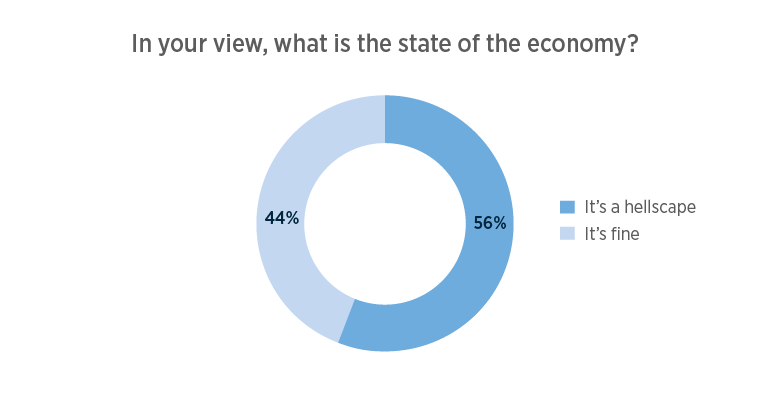
It's worth noting that Mackintosh's outlook was in sharp contrast with the sentiment expressed by many of our webinar attendees:
Two positive surprises in 2025
Per Mackintosh, two developments in 2025 have contributed to the expectation of a positive economy in 2026:
- Tariffs weren't as bad as many companies expected. The tariff shock in February and the high rates announced on "Liberation Day" in April 2025 were real, but after that, overall tariff rates declined. Companies have adjusted supply chains to source goods at lower prices. Moreover — and perhaps surprisingly — Mackintosh shared data to support the contention that, despite tariffs, it's still cheaper to import goods from most countries (especially certain Asian countries and Mexico) than to manufacture them domestically.
- The economic soft landing is still in effect. It's true that wage growth and hiring have started to slow. However, consumer spending has persisted, aided by decreases in layoffs and firings. Meanwhile, the services sector, which makes up 70% of the US economy, has retained modest growth, offsetting a contraction in the manufacturing sector.
Three tailwinds for stocks and the economy
Mackintosh also presented positive news supporting optimism for 2026.
- Tax cuts, stimulus and deregulation support growth. These measures are expected to boost both the stock market and the broader economy. While tax incentives benefit households overall, higher-income households will see the greatest impact.
- Interest rates are coming down. The day of our webinar, the Federal Reserve lowered interest rates by a quarter percentage point, its third rate cut of the year.1 Moreover, slow population growth of the type the US is now experiencing will likely lead to lower interest rates in the future. This possibility is particularly important for small-cap companies, some of which are paying nearly 50% of their EBIT in interest expense. Interest rates is one area where our attendees largely agreed, with most expecting lower rates in 2026:
- Investment in artificial intelligence (AI) is driving gross domestic product (GDP). If it weren't for investment in the tech sector (in buying chips, creating fixed assets to build AI models, etc.), we might already be in a recession — or at least growing a lot slower than we are now. AI revenues are now driving stock returns as companies are earning revenue from things like selling chips and renting out data center space.

Is there an AI bubble?
All this leads to the question of whether we're in an AI bubble. Mackintosh doesn't think so. Unlike the dot-com era, today's leading companies are established, publicly traded firms with substantial revenues.
That's not to say investors aren't concerned. They're starting to look for alternative areas of value, seeing which industries might be downstream beneficiaries. For example, they're investing in nuclear companies because they anticipate a rising need for electricity to power data centers.
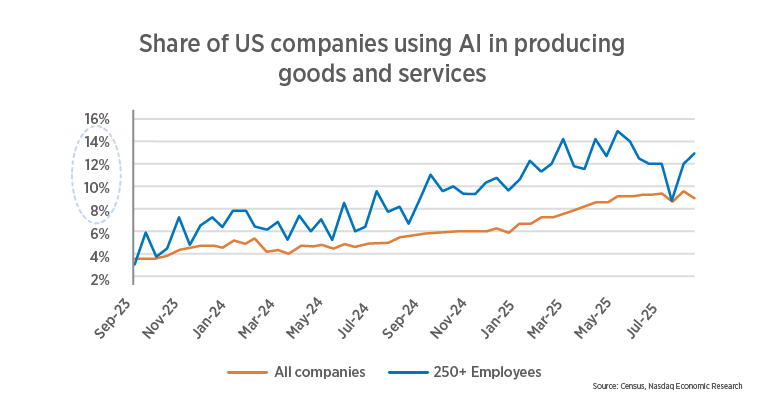
Despite all the hype about AI, it hasn't delivered significant productivity gains yet.2 A Nasdaq survey found that only 8% to 14% of companies are using AI to produce goods and services. Still, Mackintosh believes the long-term economic payoff could be substantial, emphasizing that innovation is key to economic growth.
Investor appetite is improving
One way to view investor appetite is through data showing the first-day performance of initial public offerings (IPOs). The "IPO pop" is higher now than any year since 2014 (except for 2020, during COVID's zero-interest-rate period).
Nasdaq's IPO Pulse also points to a strong end of 2025 and a solid start to 2026. Pulse indicators include lowering interest rates, low volatility, rising stock returns and strong investor sentiment.
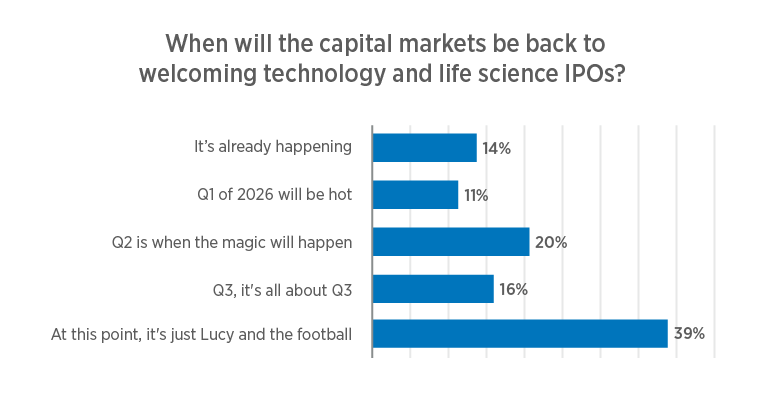
Our webinar attendees were more divided, with many expressing skepticism about the IPO market. As a reminder, however, this poll was taken at the start of the webinar, before the experts had had a chance to lay out their data.
Why does this data contradict what the press is saying?
These reports all seem to be positive, contradicting what many are hearing in the media. Mackintosh reiterates that most economists broadly agree with this outlook, while media coverage often focuses on worst-case scenarios.
"I feel like the headline right now that's going to sell newspapers is, 'It's a tech bubble, and everything's going to break,' " he said. Mackintosh acknowledged that companies that end up losing money in the AI race will lose a lot — and there will be losers. But there will also be winners. He added that some of today's tech giants rose to dominance only after the dot-com bubble burst.
When will prices come down on certain products?
Prices coming down due to sustained deflation can harm economic growth. However, decreasing the rate of inflation is positive for economic growth. This decrease is already happening — the growth rate has been slowing for the past two to three years, and this trend is expected to continue. Mackintosh is firm when he notes that tariffs shouldn't cause a major inflation spike.
There's a perception that the cost of goods has gone up significantly, but the data tells a more mixed story. It's true that some grocery costs are up, and some commodities are up — but some are down. For example, new car costs have been falling, and car insurance is starting to come down, per Mackintosh.
IPO activity rose in 2025, and 2026 looks promising
Nasdaq IPOs increased in 2025, reaching 188 as of early December. Although it's moving in a positive direction, "it wasn't the flood we were hoping for," Cassel said. The federal shutdown — which included the closure of the Securities and Exchange Commission — contributed to the IPO slowdown. At least a dozen companies delayed their IPOs from Q4 2025 to 2026.
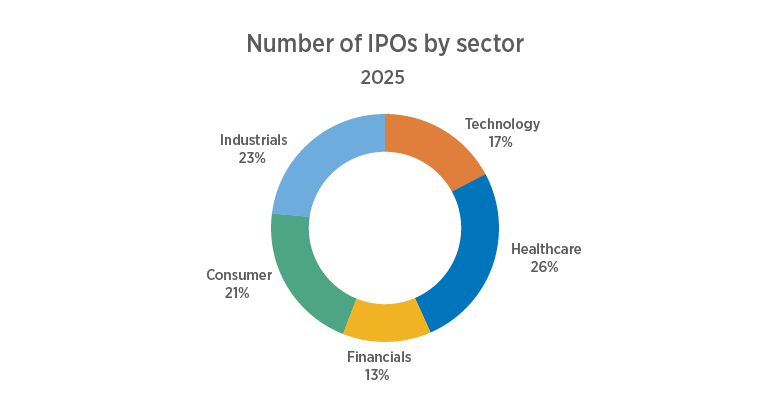
Even so, Cassel is optimistic for 2026 and 2027, citing various positive metrics and the fact that many companies are discussing accelerating their IPO timelines.
SPACs are back
In 2025, there were 129 new SPAC offerings. Issuance has increased each year since 2023, alongside meaningful structural improvements. SPACs now have stricter governance frameworks, longer timelines and performance-based incentives — all of which aim to address past challenges such as oversupply and subpar deals.
SPAC issuance is expected to remain healthy and disciplined in 2026, and forecasts suggest 70 to 100 new SPAC IPOs.
Private companies are staying private longer
Companies staying private for longer isn't a new phenomenon. Staying private longer has been enabled by secondary markets, which are seeing interest from a diverse set of investors. At the same time, investors still seek returns through exits, supporting a positive outlook for the IPO market in 2026.