
CEO pay across financial services is surging, particularly among smaller firms. Bonuses and long-term incentives dominate as part of a shift toward performance alignment.
Getting your Trinity Audio player ready...

Author: Chris Crawford

null

Executive pay in financial services companies continues to reflect both market dynamics — particularly interest rate fluctuations — and organizational complexity. Recent Gallagher data from 562 financial services industry companies in the Russell 3000 and S&P 500 stock indexes — combined with detailed breakdowns by company size, industry and compensation mix trends — illustrates evolving pay structures in this sector.
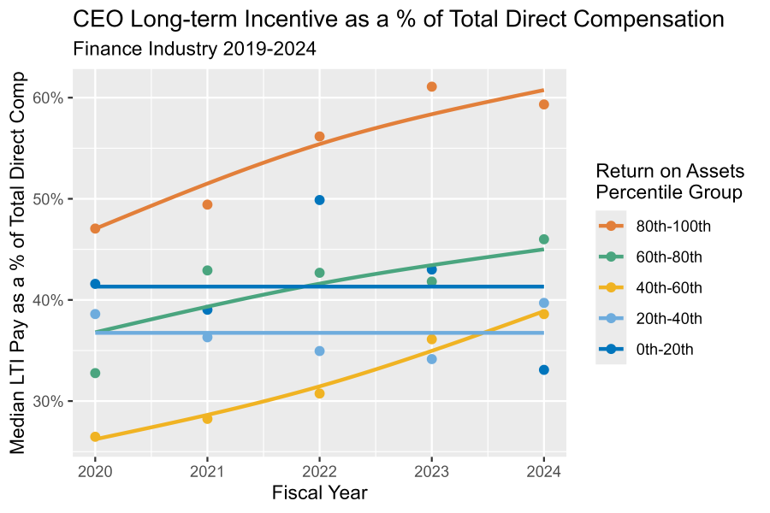
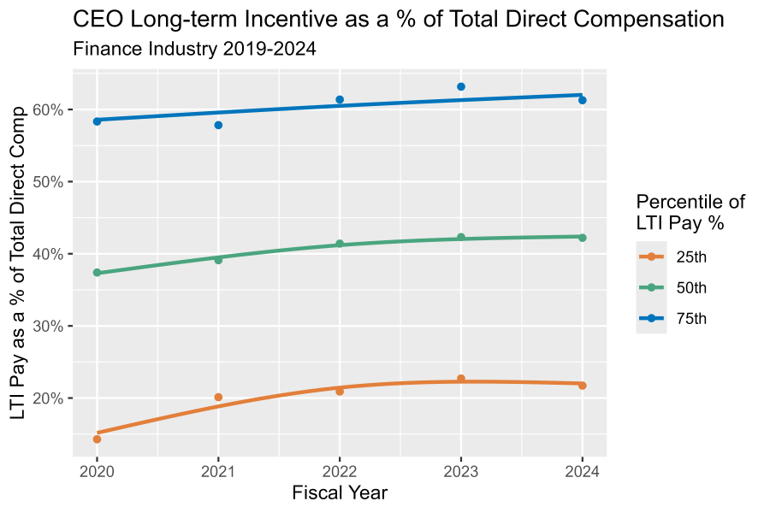
Median LTI as a percentage of total direct compensation has increased for 3 out of 5 asset percentile groups since 2019
LTI as a percentage of total direct compensation has increased since 2019

Macro-level growth patterns in financial services

CEO pay continues its upward trajectory across financial services firms, but the pace of growth varies significantly by stock index:

  • S&P 500 Financial Services CEOs: Median total direct compensation rose steadily from $13 million in 2020 to $17.3 million in 2024. Year-over-year growth from 2023 to 2024 increased 10.2%, while the five-year compound annual growth rate (CAGR) rose 7.4%.*
  • Russell 3000 ex-S&P 500 (smaller firms): Compensation surged more aggressively, climbing from $1.9 million in 2020 to $2.8 million in 2024, including a 25.9% jump in 2024 alone. The five-year CAGR of 10.9% underscores strong upward pressure on pay among mid-market and smaller financial services firms.
  • Overall Russell 3000: Median pay increased from $2.3 million in 2020 to $3.4 million in 2024, a 14.8% rise in 2024, with a CAGR of 10.3%. Median pay increases reflect sector-wide growth but skewed toward smaller firms' acceleration.

These findings indicate that smaller firms are driving compensation growth at a faster pace than large-cap peers, likely due to competitive talent markets and the need to attract leadership capable of scaling operations.

Company size matters: Asset-based pay differentiation

CEO pay scales sharply according to company size. Financial services firms earning assets less than $5 billion typically offer total direct compensation in the range of $1.3M to $2.1 million, while those bringing in $200 billion or more in assets deliver packages approaching $16.6 million — a nearly eightfold increase.

Base salary remains relatively flat across asset groupings, moving only modestly from $576,000 at smaller firms to $1.3 million at the largest firms. This trend signals that fixed pay isn't the lever driving overall compensation growth.

Instead, variable components — annual bonuses and long-term incentives (LTIs) — grow dramatically according to company size. Annual bonuses climb from $326,000 to more than $4 million, while equity-based awards surge from $306,000 to $11 million at the top end. For the largest financial institutions, equity accounts for roughly two-thirds of total pay, reinforcing alignment with shareholder value.


New Executive Pay Trends Report

Smaller firms are reshaping executive pay, with CEO compensation surging 44.7%.

Get Started

Industry lens: CEO pay levels and compensation mix

Industry-specific analysis within the larger financial services sector reveals further nuances:

  • Capital markets and consumer finance CEOs lead the pack, with median total compensation exceeding $8.7 million, driven largely by equity-heavy packages.
  • Insurance CEOs command the highest base salaries, averaging $1 million.

Our team notes that many of the companies in this category use arrangements with related party management companies for executive leadership. This arrangement produces unique compensation reporting for these entities, as the public issuer usually doesn't pay cash compensation directly to the incumbents, resulting in the zero values referenced above.

Across financial services industries, equity-based compensation increased steadily, as a proportion of total pay.

  • Banks: Base salary 25%, bonus 25%, LTI 50%
  • Capital markets: LTI dominance rose to 83%, base salary less than 10%
  • Consumer finance and diversified financial services: LTI consistently 70% or higher
  • Insurance: More balanced mix — LTI 62%, bonus 27%, base salary 11%

Compensation mix by company size

As assets grow, base salary shrinks from 20% to 7%, while LTI climbs from 44% to more than 70%, cementing equity as the dominant component for mega firms. Bonuses remain relatively stable, but peak for mid-tier firms.

As companies grow in size and complexity, their boards prioritize LTI to align CEO interests with sustained value creation. Equity-based pay ensures that CEOs benefit only when the company performs well over time, which is critical for mega firms managing billions in assets.

Fixed pay (base salary) becomes a smaller proportion because it doesn't reflect performance risk. Instead, compensation shifts toward performance-contingent rewards — stock grants, options and long-term plans — tying pay to measurable outcomes. Institutional investors and proxy advisors advocate for pay-for-performance models, especially in large-cap firms, reinforcing this trend.

The bottom line

CEO compensation in financial services companies is increasing rapidly, particularly among smaller firms and equity-driven segments. Fixed pay remains stable, while bonuses and long-term incentives dominate, reflecting a sector-wide shift toward performance alignment. For boards, the challenge lies in balancing competitiveness with governance discipline.

Gallagher can help

Gallagher uses data, technology and builds trusting relationships to design and evaluate compensations models to fit your strategic goals. Our team can work with your compensation committee to proactively analyze market shifts and determine how the incentive model may need to evolve to align with changing business dynamics.

Learn more about executive compensation at Gallagher.

CONTACT US

Author Information


Disclaimer

Consulting and insurance brokerage services to be provided by Gallagher Benefit Services, Inc. and/or its affiliate Gallagher Benefit Services (Canada) Group Inc. Gallagher Benefit Services, Inc. is a licensed insurance agency that does business in California as "Gallagher Benefit Services of California Insurance Services" and in Massachusetts as "Gallagher Benefit Insurance Services." Neither Arthur J. Gallagher & Co., nor its affiliates provide accounting, legal or tax advice.